Wednesday, September 15, 2010

Food Soulful!

Paneer makhani

My microwave tales have been almost verging on the irritating for my dear colleagues were not getting to taste anything…so theoretical renditions of fabulous microwave yields were simply grating on their nerves, and all my valorous culinary experiments were, perhaps, becoming suspicious. Finally, however, I promised them to bring something, microwaved to college. I thought of several things: chicken fry, chicken butter masala, paneer butter masala, etc…but finally zeroed in on paneer makhani. And to compliment that asked Ma to make alu ka paratha. Pure North Indian cuisine from a middle class Bengali kitchen. However, my colleagues (barring Samata) are barely bothered about the origin of a dish…they generally do not mind anything as long as it is chewably digestible.


Alu ka paratha
My text-messages started spreading the news of a hatke Monday lunch as I shopped for paneer makhani. Paneer, tomatoes, ginger, garam masala, tomato ketchup, kasuri methi, cashew nuts, butter, and milk. I was specifically worried about the kasuri methi; it was an unavoidable ingredient but Sujan is psychologically allergic to anything green. So, I had to message him in advance that he should not mistake kasuri methi for dhone pata, the latter being a major turn-off for him. Suman has already gone onomatoepic in his messages, expressing lustful anticipation for a superb Monday lunch, thereby augmenting my tension manifold. I did not inform Krishnendu, the food-freak hard to match in enthusiasm, for I wished to surprise him on Monday. And, Sujan had almost compelled me to add another guest on the list: Kinsuk. It’s not that I did not wish to invite him; but it was Sujan who had almost made me call him up injecting in me a fear that I might die repenting later if I had not.


A sumptuous amount of paneer cooked in butter base was not good for Sujan, at least. Samata and I have been advising him on resorting to a healthy diet (which meant sufficient amount of vegetables and items containing fibre), for Sujan is one big (literally too) carnivorous guy who has never known the taste of green vegetables. I was feeling a tad guilty, for inviting him to eat something I had been sagaciously advising him against having. Anyways…


Sauteed Vegetables
We had fixed 1o’clock as our lunchtime, and all five of us gathered around the table of our department. Now, Samata had a surprise. She did not tell me that she had cooked something ‘really’ Chinese for us. Samata often saves us from the atrocious canteen offerings by her delicious cheese spreads, and sometimes something from Bobby di’s kitchen. This was the first time she had actually cooked something. What? Vegetables, mushrooms and paneer sautéed in soya-sauce. It smelt so Chinese, and it tasted so as well. The recipe was unostentatious, but amazing. Well, Samata had not flouted the health rules we were trying to impose on Sujan: she had him have a purely veggie dish for the first time; and that too cooked in negligible amount of oil. Sujan’s first step to healthy eating!


The fusion spread on the table (North Indian alu ka paratha and paneer makhani with Chinese-style sautéed vegetables) looked just as odd as chalk-and-cheese, but the whole thing reminded me of the inexpert charuibhatis (picnic) we used to have years back! The ambience was actualized by the juvenile excitement of Sujan, Suman and Krishnendu…all three made it a day for us, simply by praising our effort.


I also surprised myself. The paneer predominantly tasting of kasuri methi simply melted into asking for more while the alu ka paratha rocked. I am not sure whether the food was really that good! But all of us were happy. Perhaps that seasoned the spread generously.

Image Courtesy: Sujan Chandra

Monday, August 23, 2010

Peepli [Live]: All is not so well!

The news of Jitu Bagdi’s suicide is what I woke up to today in the morning...the 28-year old sharecropper, a resident of Karotia village in the Burdwan district, poisoned himself to death, unable to payback a loan of Rs. 10,000 (approximately US $ 200), as the crops failed due to scanty rainfall. Five kilometres away, in the village of Basantapur, another suicide was reported a few days ago…Yunus Sheikh another peasant had met with the same fate having failed to repay a loan of Rs. 22,000 (approximately US $ 440). Anusha Rizvi’s Peepli [Live] delves into this grim reality, and commendably so, but despite the sincere efforts, remains somehow detached from the real tragedy. By resorting to the comic mode, it manages to be sporadically entertaining, but the way the narrative is designed is quite predictable. In fact, Rizvi makes too much of the media, and at times, the audience ends up feeling confused whether it’s a lampoon on the media or satire on a major social problem. Actually by taking the satire on the media to an irritating, unbearable extreme, the director often loses focus.

However, the film does have its sunshine moments, thanks to the ensemble cast of non-stars, each of whom delivers power-packed performances. The difficult-to-pacify, half-paralysed, petulant mother who half-rises from her shabby khatia to abuse her daughter-in-law or shout at her good-for-nothing sons and the misfortune they have brought upon the family, is someone you would look forward to as one scene fades into another. The peasant brothers are brilliant too: especially Nattha who turns into a hero overnight having declared that he would commit suicide. The scene where the two brothers fight with fraternal affection against each other as to who would commit suicide is perhaps the most comical of all the scenes, most of the others verging precariously on the slapstick. Little did Nattha know that his life would be transformed in a twinkling of an eye, and all the media attention he gets thereafter makes his life hellish. The government officials, the ministers, the local political leaders are unsparingly satirised, and much of what they do to save the peasants makes for a laughing circus, which, as it goes without saying, does not yield any results. The ending of the film is certainly a telling commentary on how peasants are forced to migrate from the villages in search of asylums in cities, where they are thrust into life-long anguish and pain, no better than the life they have left behind. The poor peasant who quietly drags his loaded bicycle past the media-mela (carrying sacks of soil he digs out from his land), and dies in the end, but does not get any media attention, is another character one may look forward to.

Now friends, a word of caution: Do not rave about Peepli [Live] because everybody is raving about it. If you do not call the film good, your capacity to sympathise with the subaltern would not be called into question. Judge the film from the point-of-view of a film critic and not a social reformer, and you would surely find it wanting. The film is entertaining stuff…and by the virtue (or vice) of being so, the film becomes a typical bourgeoisie take on a serious peasant issue, for both eyes of the business-minded producer (read Aamir Khan) were on the box-office. Yes, the subaltern really cannot speak, and that’s why the bourgeoisie can gleefully sentimentalise on their issues…and when they really speak out…well, our government is already having sleepless nights, no?

P.S: The film may also be judged as a deliberate exercise in lightening the whole issue of peasant suicides for that's what the government has been doing so far. From this point of view, the film may appear a little more appealing.


Friday, August 13, 2010

"Once Upon a Time in Mumbai": Retelling a Postmodern Myth


Are myths really timeless? Yes, they are. Is it impossible to trace the origin of a myth? No, not really. For, myths do not always belong to prehistoric times. Myths can be created every day. In fact, the myths surrounding the Mumbai underworld are perhaps the most recent, and created and perpetuated by the Hindi film industry. Beginning in the late 60s, throughout the 70s and well into the 80s, this myth has been repeated so many times that for a Hindi film-buff the villain had become synonymous with the smuggler, who lived in a palatial mansion with an underground den having electrocuted entrances and where money, jewellery and all sorts of desirable things were hidden in chambers with password protected doors and blinking red-lights. This is magic realism at its best. Postmodern fictional representation often uses a trope which is referred to as ‘literalization of metaphor’. These fantastical garish films of the 70s and 80s did not ever use the world underworld. Rather they literally situated the villain (or the don) in a den that was underground. The best example would be Mogembo’s hi-tech den in Mr. India.


The Hindi film villain was always a diabolical smuggler, who also became a tragic hero in Don. Although the villain was finally killed, and all was set aright, the glamour surrounding the underworld and the easy road to money it ensured was difficult to overlook. The city of Bombay, apart from being the epicentre of the film industry and the associated glamour, also catapulted into a much desirable destination, thanks to the rumours (sometimes truths) about how its underworld was a utopia where fame, money, glamorous women and every other pleasure was easily accessible. Milan Lutharia’s Once Upon a Time in Mumbai, traces the reality behind the origin of the myth. ‘Once upon a time’− the very title resorts to the oft-repeated first line of fairy tales, thereby cleverly juxtaposing legend and reality, for it squarely locates the myth in a real space − the city of Mumbai. Although the disclaimer denies any relation to the lives of Haji Mastan and Daud Imbrahim, the story as it unfolds, speaks otherwise. One may argue that Once Upon a Time in Mumbai is nothing new, for Ram Gopal Varma has already told the same story in his critically acclaimed Company years ago. But the novelty of this film is that it not only reveals the myth which has so far served as the main source of plot material for numerous Hindi movies of the 70s, it also goes commendably in the retro mode to tell it in the 70s way! The sets, the costumes, the high-strung acting, the power-packed punch lines, the loud background score…everything is so very 70s, after all. Ram Gopal Varma’s Company was in the realistic mode; but Once Upon a Time, true to its title, recreates the fantastically over-the-top glam-world of the 70s. The departure from the stock 70s plot is made where the film refuses to draw the line between good and bad, and explores the grey area. That a lot of research has gone into the making is clearly visible. However, my approach to the film may send out the wrong signal that I was rather impressed by the movie. Actually I wasn’t. For, after all, the plot and execution is pretty average.

Of the performances, I would rate Emraan Hasmi and Prachi Desai quite high. Ajay Devgn is quite believable in the role he plays. I did not like Kangana Ranaut, for I do not like her, generally. Thank god, she did not sit precariously forlorn on the window sill or attempt suicide in her favourite hang-out, that is, the washroom. The supporting cast does not impress for the focus is so squarely on the two heroes that they almost sleep-walk through the film, it seems. By the way, Randeep Hooda makes a surprise come-back as the tough cop and puts up a praiseworthy show, as slick as his waistline.

I do not really recommend this film, but a one-time watch, when you have nothing to waste money on, is not discouraged.

Sunday, August 1, 2010

"Inception": Maya and all that?

Well, I am still very unsure of my surroundings, although I am already four days away from the curtains closing in upon the end-titles of Christopher Nolan’s path-breaking Inception. No amount of Freud or Jung or any other psychoanalyst can really provide a clue to the narrative that very often crosses the thin line between dream and reality. It’s difficult to make the distinction; a one-time watch is certainly not sufficient to unravel the several levels of dream and reality on which the narrative operates. True, some explanation is given at regular intervals…but following the visuals and interpreting them on your own requires you to be rather alert all the time…on your toes, literally. But it’s fun! It’s like solving a jig-saw puzzle which eternally expands to become more confounding.

And inception…the title…well, it’s a dangerous thing indeed! The film claims that it is possible to implant an idea in someone’s mind and make that person believe in it so deeply that he or she loses individual ways to seeing the world. The very thought is spine-chilling. The colonization of the human mind! Shall we say this is technological imperialism taken to its furthest limit?

And, there is this incredible machine that helps one visit someone else’s dream! Just come to think of it! And once again, this machine is used to visit the dream of a business tycoon…a marvellous game is played to incept in his brains the disastrous idea of splitting up his business empire for the benefit of his competitor who pays for the whole thing. This competitor is a South-east Asian. Does the film anticipate the rise of some other world power in the near future that might jeopardize the American sway across the globe?

Whatever it is, I highly recommend Inception. It’s a must-watch for that awesome mind-spinning experience and the associated pleasurable discomfort that stays with you for a long time.

Tuesday, July 20, 2010

"Udaan": Up, up, up!

Vikramaditya Motwane’s Udaan could have been lost in oblivion had not the Cannes breakthrough happened. It’s a very small film, and every frame, though shot commendably, shows how little money might have gone into its making. Money, in this case, did not matter. The Cannes recognition did not come just like that; though not completely flawless, Udaan struck gold at Cannes by a theme which has barely found focus in Indian films. It’s a very simple yet vehement critique of gender construction, an uncompromising unravelling of the deeply flawed conception of masculinity that has often wrought political havoc. The nerve-racking conflict between Rohan (Rajat Bamacheri, quite good as a debutant…not brilliant though) and his father (Ronit Roy in his Bandini avatar) and the latter’s triumph in the end dismantle a long history of a heteronormative patriarchal hegemony. The insensitive, militant and almost bestial father is apparently the villain and Rohan and his half-brother’s monumental struggle is to free themselves from his strangling control. In fact, while the audience’s full sympathy is directed towards the helpless boys, the sensitive makers (the trio of Motwane, Anurag Kashyap and Sanjay Singh) did not allow the audience to miss the helplessness of the father as well. The father rock-hard on the outside is not butter-soft in the inside − now that would have been an unforgivable cliché. If you are sensitive enough, you would certainly feel the father’s tragic predicament in his failure to understand how inextricably he has been interpellated in a system which so strongly demands hard-heartedness, militancy and a sheer sense of utilitarianism from a man that he has altogether lost his emotional self. Two of his wives are dead (the clear implication is that they were victims of his lust or his unearthly anger), he cannot relate to his sons, and he harbours a profound hatred for his brother who, he believes, is not manly enough for he has not been able to father a child. Surprisingly, however, he refrains from meeting Rohan in school fearing that he may spoil his fun. He is aware of his failure, yet cannot comprehend the reason behind it. In an emotionally charged moment, he confesses that he is simply tired of compromising with others, a compromise that had begun with his father. He is just another generation in a long lineage of patriarchal Fathers faced with a son who challenges his fixated notions of being and becoming a Man.

Rohan’s ambition of becoming a writer is totally alien to this father who only believes in the undaunted pursuit of worldly-ends. As Rohan operates the monstrous machine in the factory, his dream seems to be ground to death, every time the machine comes thumping down. His father in a drunken state teases him about his girl-like features and his ‘feminine’ ambition. Rohan’s subalternity in the household is also shared by his six-year-old half-brother Arjun whose childhood seems to have been robbed off. But Rohan learns to speak; in a dramatic altercation with the father, he ends up physically retaliating him. He literally runs away from the house, with the father chasing him. But this time he wins the race, and the exhausted father finally gives up on him. He, however, comes back to take away with him little Arjun. They are both freed from the prison, and they head for the dream city of Mumbai.

The ending is a tad utopian, but, nonetheless necessary. Although all fathers are not usually like Rohan’s, the model of aggressive hypermasculinity is more often than not the only compulsive model available to male children. Any digression from it is met with disdain and insult, often compelling children to forsake their true selves. Rohan’s father is a hyperbolic representation of many fathers who often impose upon their male children their own image. Rohan’s protest and final abandonment of the house is a telling act that steals the sanctity associated with the figure of the father and the mute submission he demands of his wards. Udaan, therefore, is not merely a coming-of-age story as the publicity campaigns call it. It’s much more than that. Indeed, while watching the film, I felt a bit uncanny that last week only I had been cribbing about the relationship between gender constructs and being adept in Mathematics on my blog. Udaan gives an aesthetic expression to my essay on “What’s there in Mathematics?” I hope you understand what I mean.

Saturday, July 3, 2010

What’s there in Mathematics?

How many of you out there have suffered unspeakable heart-wrenching humiliation for not being good in Maths? I guess quite a handful of you, indeed! Even those who have somehow managed to become engineers and doctors! Well, all of a sudden, this morning I felt like retaliating for the endless insults naïve children have suffered in school, at home, among so-called sharper friends for having arithmophobia!

Now I was quite good in Maths, but somehow, I suffered from a constant fear that if I fail to cross that 80% bar this year, I shall fall in the eyes of my parents, teachers and classmates. Not only that, today, in retrospection, have I felt that proficiency in Maths has a lot to do with your maleness too. If you are not good in Maths, you are not a man…you are a sissy. Alarming indeed and that too in a country where a Sankuntala Devi was born! I remember that my parents were always more bothered about my marks in Maths, notwithstanding the fact that I was scaling heights in the Humanities. I almost ruefully recall that I could not even happily pronounce high scores in, say, Geography, if the marks in Maths were not up to the expectation. I knew what would follow was an awful humiliation…intimidating anticipations about my future when I would surely be left jobless. Such terrible scolding often left me dejected for days, and spent midnight oil apprehending a beggar’s future. I had seriously started believing that everything, even your life and of course, death, totally depended on your potential of solving Maths problems. My belief was strengthened as the years passed, for I witnessed a huge population of children suffering under the auspices of not being able to make out what was the use of the information that the hypotenuse of a right-angled triangle was greater in length than the two other sides.

Nobody bothers to teach children the philosophy of Maths; instead, they have attached with the subject a baggage of materialism: If you can’t be an expert in Maths, life will reject you forever! Isn’t that a criminal offence? I strongly think it is. Name one Maths teacher who can make you fall in love with Maths. Can you? Perhaps, no. For, most Maths teachers do not know how to relate those problems in the textbook with life. Now please do not take this at face value! Connecting Maths textbook problems with life doesn’t imply that knowing how to measure a line correctly can help you draw the plan of a house perfectly in the future. That’s useless knowledge! All of us do not turn into architects or goddamn civil engineers. I mean a more universal knowledge, knowledge of life! Surely, Maths can do that! But is that the way school textbooks teach the subject? Do they at all do anything rather than throwing many of us in the Darsheel Safary syndrome with its endless rubbish on numbers? Do these text books and for that matter the dolts that teach these books ever try to play with the magic of numbers and erase the fear from the little heads?

And to the parents: Do not feel at a loss when your child cannot score well in Maths. You know, that’s a good sign. At least, he or she would not degenerate into a machine. Celebrate if he or she excels in the Humanities…that would make them real human beings. I had deliberately given up on Maths in spite of a good score at the JEE. Instead I chose to study English Literature. Nothing catastrophic has happened to me, you see! I am quite successful in life, in my own little way, and thank God, calculations do not plague my peaceful slumber!

Saturday, June 26, 2010

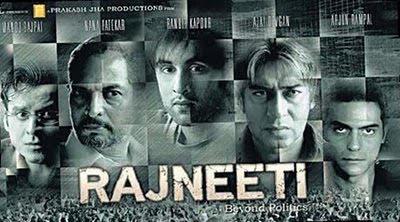
"Rajneeti": It’s for Ranbir only!

There is a famous Bengali proverb: Jaha nei (Maha)bharat e taha nei bharat e. There is nothing in India that has not found mention in the Mahabharata. Therefore, many Indian narratives, if read closely, would reveal some connection with this marvellous epic. One need not deliberately device a plot recalling the epic. Rajneeti as a re-telling of the Mahabharata, therefore, does not appeal in the first place. It would appear in even poorer light to those who have seen Shyam Benegal’s masterpiece Kaliyug. Although Anjum Rajabali, the co-script writer, claims that he has not seen this Benegal magnum opus, the film speaks otherwise. There are actually too many similarities. Benegal’s film based on the story of a business empire split into two had intelligently used tropes from the Mahabharata to apply to a capitalist post-industrial world, establishing the timelessness of myths. But Rajneeti cannot claim such artistic excellence, for one does not really need a conscious revoking of the Mahabharata myth to interpret the current political scenario of India.

What keeps you glued to the chair in Rajneeti is not the story; it’s much too predictable…it’s actually Ranbir Kapoor’s astounding Samar! You witness open-mouthed as this apparently ‘good’ boy pursuing his PhD in “Subtextual Violence in Nineteenth Century Victorian Poetry” in a foreign university graduates cold-bloodedly into a diabolic schemer at the onset of the epical tragedy that overtakes his family’s political career when his father is brutally murdered by his cousin’s men. Ranbir speaks through his eyes; his body language is so articulate that he does not need dialogues. His metamorphosis is so sudden but so believable only because this awesome actor carries off such transformation with an unmatchable aplomb. When he proposes to Indu (Katrina Kaif) he manages to emulate genuine emotions in his voice, although he does not love her. Simultaneously, he also manages to send a shiver down the audience’s spine for he is able to send the message across that he is making this compromise only to win over Indu’s father’s financial support of his party. The undertone of the satanic schemer does not once mar the ingenuous tone of the proposal, but compliment each other. Ranbir takes a very large slice of the cake in the acting department indeed leaving a very small portion for the others to lay claims on.

However, Nana Patekar impresses with his subtle performance. Arjun Rampal has managed to gather a little more than the infamous two-n-a-half expressions that hang on his face all the time. Ajay Devgn and Manoj Bajpai irritate. And Katrina Kaif? Would someone please show her the exit door? She has all kinds of weird expressions on her face which she mistakes as ‘acting’…expressions murderous (literally!) enough to compel you to leave the theatre. Thanks heavens, her presence is rather negligible compared to the huge retinue of male actors. And the hype and hoopla surrounding her Sonia Gandhi act is a wonderfully misleading publicity stunt. She appears in that famous cotton saree for two-n-a-half scenes, much to your relief, of course, and that too at the fag end of the movie. And what acting! O my God! Her eyes and her lips (and whatever comes of it in atrocious Hindi) are so out-of-tune with each other that the scene appears to be one of those American Teleshopping advertisements dubbed in Hindi. All Katrina Kaif films must henceforth carry with them in no ambiguous terms a statutory warning: Watching Katrina Kaif act may be injurious to your psychic well-being. Come at your own risk!

Well, Rajneeti has been declared a box-office hit and the Jha camp is going gaga over it. But it’s not a good film; an average venture in all sense of the term. Due to lack of other solid competitors it has managed to draw the audiences to the theatres, the failure of Ravaan, for example, adding more to its success! I would contend here that Prakash Jha is more in his elements on a smaller canvas. He is a good filmmaker; no two ways about that. But in Rajneeti, under the compulsion of generating a full-fledged entertainer, he had to do away with attention to details. It’s true that Indian politics has undergone a remarkable degeneration, and the film fittingly captures it; but it should have been more specific and individualistic. It seems to be a rather long sweeping statement on the degeneration of politics at large. The director does not even bother to locate the film. The map of the state often shown is a vague simulacrum of the state of Madhya Pradesh. But contemporary cinema has come a long way to be bold enough to be specific about its setting. Had the film been made in some other mode, apart from the realistic one, it could have afforded to be that fuzzy. But not in a realistic mode, no matter how melodramatic it may be! It cannot afford to be “Once upon a time somewhere in India…” story. Nonetheless, it’s a good one-time watch; only blind yourself of Katrina’s catastrophic presence.

Note: I have even chosen a poster without Katrina in it!

Sunday, June 6, 2010

"Mahanagar@Kolkata": Postmodern City Blues


Michael de Certeau in his renowned piece “Walking in the City” writes:


Their story begins on ground level, with footsteps. They are myriad but do not compose a series. They cannot be counted because each unit has a qualitative character: a style of tactile apprehension and kinaesthetic appropriation. Their swarming mass is an innumerable collection of singularities. Their intertwined paths give their shape to spaces. They weave places together. In this respect, pedestrian movements form one of these ‘real systems whose existence in fact makes up the city’.
This is so true of Suman Mukhopadhyay’s Mahanagar@Kolkata: it captures contemporary Kolkata by collecting singularities and merging them together in a dramatic mingling of three short stories by Nabarun Bhattacharyya recalling an outstanding Bollywood flick Love, Sex Aur Dhokha (See review below). The title unambiguously alludes to the 1964 Satyajit Ray classic Mahanagar, the new codicil @Kolkata underlining the city’s ushering into the globalized e-world. Certainly the city has made a long journey since Ray’s Mahanagar; the skyscrapers harbouring offices and commercial centres that crowd the final scene of the film have now become the abodes of estranged relationships, of suicidal men and women, an existentialist angst having crept into their very being. Promoters, an MBA-holder, a night-club regular proficient in Marx, a modern day wife unable to connect with her husband, a corporation officer, a tea-stall owner living in the slum, a superstitious father, and a dark gang having clear connection with political parties: their paths intertwine to make the city and how!

Manmotho (Anjan Dutta) and Jagadish (Biplab Chatterjee) meet on the premises of a government-run hospital and witness a brutal political murder. The hospital has by that time turned into a den where party-backed goondas hide, pretending to be ill, and taking in prostitutes every night. Jagadish’s weird belief that nothing can go wrong with him for he carries with himself a piece of rope used by a maid to hang herself unsettles Manmotho visibly. In a surreal night of wind and the rain, while Jagadish narrates his intriguing story of how he got hold of this exclusive piece of rope, an imbecile murder is committed. Jagadish continuously appeals to Manmotho to blind himself: “Don’t look!” It’s a kind of blindness which all the city-dwellers have voluntarily adopted, for that is the only survival strategy. But the irony of it all strikes in the next story when Biren (Arun Mukherjee), a poor man who thrives on others’ favour, is deeply perturbed by a murder in his locality, apprehending an-eye-for-an-eye war to follow soon. His belittled status makes him a laughing stock. His continuous exercise at acquiring assurance by asking all and sundry “Amar kono bhoy nei to?” (“Should I have anything to fear?”), encapsulates the very absurd condition in which every dweller of the postmodern city is caught. Biren’s character recalls so many others of black comedies. When Biren is really killed in a prank played on him by a party-backed goonda of the locality, the latter reiterates the question − Amar kono bhoy nei to? − which makes you feel a shiver run down the spine. You suddenly feel so terribly insecure, for the well-known city is frighteningly defamiliarized! What danger is waiting for you round that corner, so apparently familiar and safe? Do you really have anything to fear? Certainly you have. Only that you do not know it’s nature. Something continues to haunt you from this point on, and stays with you even after you have safely returned home.

Satyajit Ray wished to call his Mahanagar, A Woman’s Place, in English. But that did not happen (The official English title turned out to be as unimaginative as The Big City). But in the gendered space of the city, the woman has always been treated as the subaltern. Ray’s heroine gave up her career protesting against the injustice done to an Anglo-Indian woman. That’s the best she could have done in the face of patriarchal butchery of a woman’s honour. The women in Mahanagar@Kolkata are apparently more liberated, perhaps more empowered. But Suman Mukhopadhyay locates them in history, revoking the unspeakable injustice done to them in the past in public: the vicious Sati. The modern day woman, though liberated, has in her unconscious the terrible memories of the inhuman act deeply embedded. So, in a surreal sequence, we find Rongili (Rituparna Sengupta) undergoing the paraphernalia surrounding the bride to be sacrificed at her husband’s funeral pyre. Incidentally, she is on the verge of separation from her husband Rohit (Chandan Roy Sanyal) who suspects that she is sleeping with some other guy. In the surreal sequence Rongili’s constant companion is Kamalini (Sreelekha Mitra), the night-club queen, least prejudiced about sex and relationships, and someone who dabbles with Marx. Yet, she too is a victim of the patriarchal system, and undergoes the experience related to Sati, although indirectly.

The open-sky economy has opened up immense job opportunities for the educated middle class. We have come a long way from the 1960s, when Ray’s hero, having lost his job, sulks at home. In E-Kolkata, MBA degree-holders float like sewers beneath the roads everywhere, and are barely out of job, no matter what inhuman slavery they are compellingly a part of. Rohit is one such new age hero, although there is nothing heroic about him. For, there are no heroes any more. Suspicious of his wife’s adultery and unprepared for beginning a family, he undergoes tremendous stress, characteristic of the Genex crowd of the metropolis. As in a moment of crisis he takes off his clothes one by one, and madly breaks into a song with his guitar, he screams out his soul as it were…perhaps some emotional protest against what he exactly can’t figure out. Chandan Roy Sanyal is simply brilliant in this particular scene.

Mahanagar@Kolkata is a cult film in its own right…a new way of looking at our city. Although the cinematography is a bit too dull, an excellent script is its strength. Rupam Islam’s music does justice to the theme, and on the acting front all have delivered satisfactorily. Mostly claustrophobic, the film somehow inspires the need to feel this claustrophobia deeply. Squarely located in contemporary West Bengal and its turbulent political atmosphere, Mahanagar@Kolkata mutely apprehends an apocalypse. Suicide, death, violence, corruption and above all the death of compassion shock us…we can no longer afford not to look at things. The voluntary blindness we all have adopted cannot really help us keep that unknowable FEAR at bay.

Saturday, May 8, 2010

You’re standing beyond the reaches of my song…

That’s what the great maestro ruefully sung. His intense urge to unite with the Infinite has found expression in song after song. The union has sometimes seemed almost complete, sometimes impossible…but the appeal never stopped. Ironically enough, while composing such songs, the poet had ended up creating another order of that Infinite. And today, on his sesquicentennial anniversary, we, the lesser mortals have found for ourselves the definition of that Infinite: it’s the Poet himself! Every composition, how insignificant it may be, aspires to attain to that order of the Soulful Infinite. Tagore, for us, has turned into that Shelleyan skylark, the symbol of uncontaminated joy and unpremeditated art, albeit his sweetest songs tell of our saddest thoughts, they have all reached that unreachable: a perpetually flowing river of happiness, where we all stand, wishing to realize that Infinity in our humble attempts at giving expression to life! The craving to merge with the poet would be and has always been a life-long quest for all of us…a quest which is never-ending, but, certainly, worth pursuing.

Wednesday, May 5, 2010

From Che to Mickey Mouse: Everyday Signs of American Imperialism

Today while reading a light-hearted article on how Mickey Mouse images abound everywhere, from the walls of parks to advertisement hoardings in Kolkata, I suddenly realised that the same is also true of Che, or Ernest Guevara, who, in the past few years, has become the most favourite T-shirt graphic. These ‘Che’ T-shirts have become somewhat ubiquitous, although teenagers sporting these are seldom aware as to why the man really deserves to be inscribed close to their hearts. Brought into fashion by an American company, these ‘Che’ T-shirts have now flooded the market, having been infinitely reproduced by local companies, and being available at an exceptionally cheap rate. It’s difficult not to spot one ‘Che’ T-shirt on the streets of Kolkata on any given day, as it is difficult not to spot a Mickey Mouse featuring on everyday objects. In fact, both Che T-shirts and the Disney cartoon have become so commonplace that we hardly notice them as staring out of T-shirts or even from bath towels or pillow covers. Yet, if both these figures are remarkably oppositional in the discourses they remind us of.

Although ‘Che’ is more often than not worn for he has a marvellously handsome face which may easily pass as a rock-star’s, his face recalls for many his unyielding struggle against American imperialism in Cuba, Congo or Bolivia, where he died fighting the monster, single-handedly. His very demeanour, the tales surrounding his political career as a revolutionist have gone into the making of a romantic image in the popular imagination, the romantic face of socialist revolution. On the other hand, this apparently innocent Mickey Mouse who enters our classrooms and our moments of fancy has undergone several mutations in its representation, every time cunningly adjusting itself to the changing cultural climates, always keeping intact the supremacy of the United States of America and propagating its invulnerability in the face of the apparently insurmountable economic or political challenges. For instance, the comic strips of the Mickey Mouse and the Three Little Pigs acted as appropriate symbols for the Americans during the Great Depression: these characters epitomized courageous optimism at the time of great crisis. Again, during World War II, particularly during the Holocaust, Mickey Mouse was used to damn Hitler. After the war, the Mouse became the policeman to the world; as a comic he was replaced by Donald Duck who appropriately turned into an apogee of the age of capitalism. The commonest critique of Walt Disney cartoons holds that he promulgates an American way of life as the only possible way of life. Any culturally conscious person should be able to recognize that my interpretation of the Mickey Mouse comic strips is nothing original, but a mere reiteration of what appeared in the hugely famous book How to Read Donald Duck: Imperialist Ideology in the Disney Comic by Ariel Dorfman and Armand Mattelart, two Latin American writers. This book was banned in the United States, for it tellingly deconstructed the cultural function of the Disney comics.

While it’s therefore understandable why Mickey Mouse-s abound everywhere, it may be a little baffling to read the abundance of ‘Che’ T-shirts on the same lines. But it should not be so. For, the most popular face rivalling the neo-imperialist must also be repeated infinitely and anxiously. The neo-imperialist is smart enough to acknowledge his enemies, for in the tales of their defeat are contained stories of his own sustenance. The discourse of imperialism can never be unidirectional: the subject of imperialism is as much responsible in shaping the discourse. Every time, the ‘Che’ image is repeated, the imperialist’s ego is gratified. It also constantly reminds the imperialist that his project is not without contest, and therefore, it needs to be always watchful of threatening elements. May be the ‘Che’ T-shirt on a South Asian teenager who is at the receiving end of American imperialism may still resonate with a different meaning altogether! But, who actually cares?


Saturday, May 1, 2010

Culinary Chores

My culinary expertise, I believe, has been transmitted to me through my genes, for my Mom is a great cook and so was my Grand-mom! Now that’s nothing new, for everybody feels that they have behind them an interminably long ancestry of cooking proficiency…specially boys who never really stop comparing their moms’ kitchen skilfulness to their wives’ cookery callousness, and no matter, how well their wives cook, they cannot really extricate themselves from this Oedipal Gustatory Complex! But, the wives never question their husbands’ sloppiness in cooking, and continue to bear the burden of inferiority all through their lives, although with ear-splitting protests. The question, they should ask their husbands at the very outset is that, instead of being so sadly nostalgic about their mom’s culinary potentials, why didn’t they, anticipating such cooking catastrophe, had not already learnt from their mom’s the trade secret? For, culinary expertise is also very well transmitted through genes, and it surely does not have gender bias! So, the mother can very well continue to live on in the son, and the poor wife may be spared of her kitchen duties, and relax!

However, I have no such problems, for I am happily single, till date! Yet, I have of late, began to exercise my cooking skills, much to the surprise of my mom, who is rather disconcerted that her monopoly over the kitchen is being considerably usurped. Every time I decide to cook something, my mother goes out of her way to help me with the paraphernalia of chopping and cutting vegetables, pasting spices and arranging the utensils, everything! Therefore, the credit of cooking a dish does not wholly goes to me! A strange battle is fought on the kitchen table, a battle which my Mom does not realise she is actually fighting. I have never pointed that out to her, and I shall never…for, I completely understand that the only space which she can claim to be her own (like countless other women of her country) is perhaps the kitchen. That does not mean that the other spaces are not available to her; but she is most surely the master of this particular space of the house. Hence her involvement. Of course, she does have other concerns that I might cut myself or burn my fingers…but nonetheless, I can feel her anxiety!

But I am an awfully lazy person! I would have barely braved the kitchen so frequently, had not there been a tech-revolution. My new enthusiasm in cooking solely rests on the Microwave which has invaded and colonized our kitchen a few months back. Although, I boast of carrying forward excellent cookery genes to make my entire maternal ancestry proud (for my paternal grandmother is anything but a cook), it is the Microwave and its several heat-adjusting buttons which really create the magic. A Sanjeev Kapoor recipe book remains open on my table from the very beginning to the end, and I follow each step rather punctiliously. And, what emerges out of the oven is generally edible. This, in fact, has become my favourite pastime of late, for the Microwave never-endingly fascinates me with its computerized culinary adroitness. Yet, at the end of every cooking expedition, I do feel a little morose, although the taste may be quite appealing to the gustatory sensations. The cause is something else: it’s like feeling objectified by the very object I have tried to create. Sounds complex? This is because the Microwave seems to smile back at me almost mockingly after I have finished cooking a dish: What have you done? The credit is mine! You know, it is this Microwave, which practically taught me what Marx meant by ‘alienation’ some one and half centuries ago.

Friday, April 23, 2010

The New World Cup Teaser and Fossilization of Africa


Incidentally, while re-reading Ngugi Wa Thiong’o’s Decolonizing the Mind: The Politics of Language in African Literature, my eyes fell on a television teaser of the upcoming FIFA World Cup sponsored by Castrol GTX. Ngugi, as many of you would know, in his drive at decolonizing the African mind, vehemently rejects European languages as means of expression; he even opposes Africanization of the colonizer’s language. While delving into the paradox of the postcolonial continent, he observes that the neo-colonial ‘comprador ruling cliques are…quite happy to have the peasantry and the working class all to themselves: distortions, dictatorial directives, decrees, museum-type fossils paraded as African culture…all these and more are communicated to the backward masses in their own languages without any challenges from those with alternative visions of tomorrow who have deliberately cocooned themselves in English, French and Portuguese.” While at home, the colonization of the lower classes continues, the images which have become associated with Africa, through the cultural discourse of colonialism, have not really changed. The Castrol teaser shows two young men accidentally falling through an empty Castrol container to emerge in the middle of a dense forest with two lions staring at them; next, they materialize inside a cauldron carried by two native African men in the midst of a tribal procession (made slightly comic…note the expression on the faces of the native men, and how the two boys are appalled by the prospective of being sacrificed; obviously, hinting that the tribe is unambiguously cannibalistic), and finally they pop up in a the middle of the stadium when John Abraham lifts them up. The motive of the ad is to convey to the world that the next World Cup Football is going to take place in Africa. What is painful is that Africa still conjures up in the minds of people across the globe wild animals and weird nocturnal rituals at the heart of the forest! This is, no doubt, an African reality. But, the approach to it is one of comic condescension…a sense of cultural superiority making itself visible in the expression of the two men, incidentally South Asians. And, besides, isn’t Africa something else too? You can’t blame the ad-maker, for he/she has correctly tapped on the popular imagination of the world, when it comes to Africa. What we may ponder over is the immense power of Western cultural imperialism and its tremendous capacity of image-creation! What flustered me is that whether decolonization of the mind is ever possible. Ironically, when such a global phenomenon (that is World Cup Football) is to take place in the continent, age-old fossilized images of the continent continue to act as its identity! It’s undeniable that even before the ad ends, all of us know it has something to do with Africa. For, in our collective unconscious we have always imagined Africa like that only. Who is going to erase such an image…an image that was culturally made current by the European colonizer to justify his imperialistic project in the unsuspecting continent? No academic appeal to reject the language of the master can really affect any overnight transformation. It’s not possible. The disease is too profound to be remedied.

Tuesday, March 30, 2010

Love, Sex aur Dokha: Experimental at its best!

It’s been really long since we have seen such an experimental film. It’s claustrophobic in the sense that it gives you a terrible feeling that you are under the constant vigilance of an unseen eye! Kind of a Foucauldian panopticon syndrome…the very watchfulness of an unknown pair of eyes that would make you feel imprisoned when you are apparently free! The entire film is shot in a hand-held camera that triples up as the camera of an amateurish filmmaker, the spy-cam of a departmental store, and the hidden camera of sting operation. All three are love stories…the first inspired by the iconic DDLJ, a deglamourised intertext of the same working in and out of the narrative underscoring the remarkable difference between the dream-like romantic world of Bollywood and the murkiness of the real world. The second draws from several MMS scandals that have flooded the internet! The third is based on a sting operation…the project of a news channel to unmask a pop-star, by revealing to the world his casting couch. The film does not resort to any kind of commentary for its difficult to even feel the presence of a director…for in all three stories the camera is controlled by the characters. We see what the characters within the film wish us to show. It is difficult to recall any film where the director is so completely absent. By absenting himself, the director seems to have put the responsibility of telling their own stories to the characters. ‘Mind-blowing’ would be an understatement. It’s brilliant, it’s awesome! In spite of all the experiments, the film does not bore you even for a minute. I had fallen in love with Dibakar Banerjee when he had gifted us with his awesome Khosla ka Ghosla…the respect for him has increased manifold after Love, Sex aur Dhokha! The Indian film industry has really matured…no doubts about that! Three cheers for Indian films! And one more thing...You need no stars to make a good film!!!

Friday, March 12, 2010

The Great Famine: Middle Class Bengali Men and the S-Word Mania

Let me warn you at the very outset: this post is not meant for hypermasculine, militant, sexist, insensitive men!

Have you ever stayed with a bunch of young catastrophically middle class (not to say LS) Bengali men in the same room? If not in the same room, you have certainly shared space with this species in some point of your life. But staying in the same room is a different ballgame altogether. Provided you are sensitive, intelligent, insightful, basically tolerant by nature, and not sexually starved, and of course, do not subscribe to the Victorian morality and taboo associated with the s-word, you are sure to sense some kind of claustrophobia growing into your soul and threatening to eat you up. I have never experienced a real famine; but my stay with a bunch of these men (hypermasculine and sexist at its worst) has given me a fair idea how insufferable it is! It’s a suffering which these people do not recognize as suffering, for they have pitifully become used to fantasizing about s-related things, in the most crudest way possible for the ‘real thing’ is a taboo to them, and bask in the pleasure of having ventured into ‘forbidden territory’ by watching downmarket pornography and discussing aloud the power of the male organ, at their mother’s, girlfriend’s or wife’s back! Hey, they are that regressive, believe me! They still believe that power resides in that protruding tool, the fantasies and meditations on the dimensions of which occupy many many important moments of their life.

Let me describe a typical evening, well morning…no night…actually anytime of the day, how does it matter? What you would immediately recognize is that, that is if you are that insightful and objective, that no matter what time of the day it is, they, at the slightest opportunity, plunge into lewd jokes and juvenile puns which might not have interested you even when you were in school, almost effortlessly. These jokes often give way to the narration of other peoples’ experiences on bed. These tales mostly work themselves out through the binary of the strong man and weak woman. The man in these stories could well replace Jackie Shroff in the Musli-Xtra Power ads, and is enviously appreciated by the narrator and his intent listeners. Sometimes the binary is reversed: these stories have Circe-like women who really know how to dominate over the men. If you closely follow the expression of the narrator and the reaction of his listeners, you may notice a thin streak of fear and of course, disgust for the heroine who dared to…you know what! All this is of course drowned in unthinking laughter, for they have been interpellated into this convention that once a lewd joke is said, you need to laugh, no matter how terribly stupid it may be! And when, they are not cracking these mind-boggling and suicide-inspiring jokes, they watch pornography. Most of them use their newly purchased laptops to this much celebrated noble end of watching porn, and their degree of popularity is contingent upon their ability to provide the starved population with endless supply of nudity. See logic in this: which neta wins the election? Of course, the one who can meet demand with supply! In this case, the supply is usually measured in Gigabytes…the more Gigabytes of porn the more popular you tend to be! And you cynics out there blame Rakhi Sawant for her endless stunts for cheap popularity! See, what you are missing out! Well, ironically, these Gigabytes also measure out the depth of their sexual frustration, mind it! It's a different thing, that they do not realise this.

And one of my very nice female colleagues who has no choice but to participate in this male homosocial group, most often than not, finds herself at the receiving end of several bawdy jokes…but has a big heart to laugh them away, only lamenting that she can’t believe that she is, by default, the chosen site for the ‘libido sublimation’ of these famine-stricken guys! And she says that aloud! But the impact of such humour is lost on them! For, most of these guys do not understand English, and let me tell you, they are college teachers! Ha ha ha! Shocked? You are in West Bengal, my dear, which was officially de-English-ed some two and half decades ago.

And, once in a while, when pornography does not interest them, they watch heroic films such as Troy, appreciating the hypermasculinity of Achilles and the brotherly affection of Hector (now and then, rewinding and pausing to ogle at Helen’s exposed parts), or World War movies, imbued with belligerent violence. This female colleague of mine, aware of my interest in Gender Studies, has asked me to turn my gaze away from books and focus on this reality I am an unfortunate part of. And, she is right! Very right! Well, I surely would, provided I survive the painful claustrophobia of having to live through this great famine in which these men are caught up for life!

Monday, March 1, 2010

"My Name is Khan": Fighting Terrorism the Bollywood Way

Interestingly, at Fame, My Name is Khan is preceded by or intercepted by trailers of films having titles such as Lahore and Tere Bin Laden. All of a sudden, and perhaps, deservingly so, Pakistan, Afghanistan, the Al-Qaida, and terrorism have entered the Bollywood scriptwriter’s favourite-list. There’s nothing to believe, of course, that these scriptwriters are dying to fight a social cause; for, Bollywood is far too commercial to do art for art’s sake, or address a social cause out of a sense of necessity. The eye is always on the box-office and these days themes related to terrorism are fetching money. For a hardcore commercial filmmaker like Karan Johar, My Name is Khan is just another project that he thought would set the box-office bells ringing. To the theme of terrorism, he adds another crowd-pulling formula: a diseased protagonist. Taare Zameen Par had made dyslexia an upmarket disease; and Paa had projeria raising the expectation bars. Now you have Asperger’s Syndrome! And why do you think actors like Amitabh Bachachan and Shah Rukh Khan enthusiastically take up these roles? For, they all of a sudden realize that they need to act seriously. Portraying a diseased character gives ample opportunity to act, really. So, the preoccupation with rare diseases and the filmmaker’s show of social awareness should be taken with a large pinch of salt. Everything is fixatedly focussed on the box-office return. While sympathizing with SRK and wiping your tears with the edge of your handkerchief, do not overlook the economic side of it all. By the way, let me clarify at the very outset that SRK is extremely loveable in MNIK. I haven’t seen anyone suffering from Asperger’s Syndrome; I guess very few people have. But, somehow SRK makes it look convincing, although a reality-check on it is a little difficult.

Postmodern history is best understood through stories of the individual who not always makes to the headlines, but has the historical moment inscribed in him, in his body or his psyche. So, postmodern literature and cinema turn to the individual and relate history through narrating the personal. My Name is Khan captures the historical moment of a paradigm shift in world history, the fateful 9/11 incident that divided the world into “us” and the “Muslims”. Rizwan Khan goes out into the world to destroy this binary, having lost his stepson in a racial fight on the soccer field, post-9/11. The odyssey he undertakes across America to meet the President takes him across ethnic cultures that shape the American multicultural melting pot. This odyssey is for the sake of love; for, his emotionally shattered wife asks him to visit the President and tell him that “My name is Khan and I am not a terrorist.” Deeply hurt, almost insane with grief, Mandira holds her marriage to a Muslim man responsible for his son’s predicament. As she continues to fight for justice, Rizwan tours the US seeking an opportunity to meet the President and ends up in jail while he is mistaken for a terrorist at a meeting in which George Bush is the chief speaker. Assisted by the media, Rizwan is freed, but he refuses to return to Mandira who has by this time realised her mistake. A terrible hurricane strikes Wilhelmina and Rizwan braves all odds to save Mama Jenny and her son, a black American family that had given him shelter. He becomes famous overnight and moves all and sundry into playing the Good Samaritan. American history sees a remarkable turn with an African American President coming to power. The television channels splash headlines such as the “Victory of Democracy” while Rizwan recovers from a serious injury caused by a Muslim fundamentalist. He finally meets the President, and announces that he is not a terrorist. He emerges as the spokesperson of a community which has been suffering since 9/11, for wrongs which they were never responsible for. Several emotionally charged moments add up to a sentimental climax, a la KJo films, and suddenly all seems well in the classic Hindi film style ending. This is where the film loses the audience’s sympathy.

It’s commendable that the filmmaker tells the story from both sides as evident in the loss of Rizwan-Mandira’s white journalist friend who is sent to cover the war in Afghanistan. Rizwan weaves his story of loss in the insufferable story of the Black Americans, those who lost their near and dear ones in the Iraq war. Again, the 1983 Hindu-Muslim riots in Bombay appear in the flashback. The film cuts across borders, national, ethnic or otherwise, by telling the whole story through the eyes of a man who sees the world as divided into two kinds of people: good and evil. Rizwan’s simplicity is that of a child, so is his innocence. Perhaps the film advocates a return to the lost days of innocence when labels hardly matter.

SRK as Rizwanur is simply loveable. The moment of the film is that when Mandira proposes to him in the backdrop of the high rises of San Francisco bathed in the halo of dawn and he acts coy, covers his face demurely. Kajol looks rather fatigued; kind of disinterested in what she is doing. The chemistry does not work! No, it doesn’t. Gone are the days of Kuch Kuch Hota Hai! The other actors are more or less okay. The music with a heavy doze of Sufism sets the right kind of mood. Sajda really rocks!

My Name is Khan is good; but not great. The film in a way reassures that the Bollywood hero is still alive. So what if he suffers from Asperger’s Syndrome! He is still the braveheart, the Good Samaritan. In this sense, the film is rather traditional. The hero does not fight petty villains anymore; he is saddled with a larger responsibility of fighting a global war of love and hate and he emerges successful in the conventional Bollywood style. MNIK could have been a landmark film had it not been so traditionally Bollywoodish after all! Go for it; it deserves a one-time watch despite numerous loopholes in the plot.


Saturday, January 23, 2010

Rituparno Ghosh’s Abohoman: Men, Women and Love


Rituparno Ghosh’s latest venture Abohoman (Since Time Immemorial) raised storms as many found similarities with Satyajit Ray’s much-gossiped-about affair with actor Madhabi Mukhopadhyay, a claim Ghosh has been rejecting vehemently in every interview. Ray’s differences, due to this alleged affair with the actor, with his wife and son had come under media scanner, and were widely speculated upon by the Bengali middleclass. This affair has till date remained a luscious Tollywood scandal, although Ray and his family had always been rather guarded about it. But, Bijaya Ray in her memoir has often insinuated at this affair, but has drawn the line before revealing intimate detail. A film based on this scandal, or as it has been publicized by the media would definitely draw the crowd, especially middle-aged middleclass Bengalis. 


The connection with Ray is most evident in the manner in which Ghosh has designed Aniket’s study. Ray seated in an armchair amid a sea of books in his study is quite a familiar image to Bengalis. Ghosh revisits this image in Abohoman by way of which he quite unambiguously suggests what is being speculated. Shrimati alias Shikha’s (Ananya Chatterjee) arrival at Aniket’s funeral in full makeup, straight from the stage, is reminscient of Madhabi’s arrival at Ray’s cremation, with surma in her eyes. Apart from these two easily recognizable similarities, the film travels beyond the biography of a well-known filmmaker to narrate the tale of a director and his muse, an age-old story, as attested by the title of the film. 


The film within the film tells the story of Binodini Dashi, the legendary nineteenth century Bengali theatre actor, and her tryst with life on stage (till then an essentially ‘male’ domain), her admirers, and her mentor. Ghosh’s Binodini is proud, impulsive, seductive on the one hand, and emotional, unrelenting and persevering. Binodini’s self-anagnorisis lies in the acquisition of the knowledge that she is indeed an actor, a puppet hung from the invisible hand of the patriarch. Essentially the film is an artistic take on the position of women in the world of entertainment, a dreaded public space where they are most vulnerable. Even if there is recognition of their talents (in case of Binodini as well as Shrimati), they are never real actors, but passive recipients. Ironically, the film’s title, while alluding to the eternal romantic bonding between the director and his muse, also alludes to the broader man-woman relationship, in which the power dynamics are still unaltered, even in the new globalized world, and its neo-liberal hullaballoo about women’s liberation and empowerment. It’s the same power equation: the man vehicle of the agency and the woman the passive performer. The age-old binaries of the rational/irrational, active/passive, or intelligent/emotional do not seem to have changed. The housewife (played by Mamata Sankar) complains of betrayal; so does the actor of the nineteenth century as well as the present day. The complaint, I guess, is less against an individual; rather it is against a system so deep-rooted that it’s impossible to to be dismantled. Interestingly, even if we assume that the complaint is against an individual, say director Aniket or theatre-magnet of Renaissance Bengal Girish Ghosh, both these individuals are much too aware of the plight of women. Aniket, for instance, reads out to Shrimati tales of prostitutes: “Hinger Kochuri”, “Barbodhu”, and others. Tales of the ‘other’ woman, an eternal outlaw inhabiting the fringes; yet without whom the centre cannot function. Actually, the tales of these prostitutes in a way become commentaries on the eternally marginalized position of women: the prostitute’s ‘otherness’ is visible; the housewife’s isn’t. But both are equally dominated. And this story is really really old…as old as eternity: abohoman. But, as with all Rituparno Ghosh films, the victimhood narrative becomes a bit tiring towards the end. The film-with-the-film, in particular, makes of Binodini a sentimental heroine, and suppresses the other side of her story, for instance, the power she exercised in bringing out her autobiography, despite insurmountable odds. I felt that way Ghosh has not been fair to her. 

The film offers three very powerful performances. Ananya Chatterjee steals the show with her freshness, although she is not quite up-to-the-mark as Binodini. She seems to imitate Madhuri, perhaps, on Ghosh’s instruction, for he wanted Madhuri to play the role initially. Mamata Sankar emotes as effortlessly as she breathes. Dipankar De is extremely believable. The others are just about okay. The background score and the music would score really high. Ghosh’s attention to details is hardly questionable, although the scenes are mostly shot indoors, thereby the gigantic task of recreating early modern Kolkata has been cunningly avoided . However, I felt that the film within the film telling Binodini’s story could have been shot in black and white or sepia tone. That would have made it more believable. After two debacles (Khela and The Last Lear) and an average attempt (Sab Choritro Kalponik), Rituparno Ghosh seems back to his elements. He would not disappoint this time.