Showing posts with label Ajay Devgn. Show all posts

Friday, August 13, 2010

"Once Upon a Time in Mumbai": Retelling a Postmodern Myth


Are myths really timeless? Yes, they are. Is it impossible to trace the origin of a myth? No, not really. For, myths do not always belong to prehistoric times. Myths can be created every day. In fact, the myths surrounding the Mumbai underworld are perhaps the most recent, and created and perpetuated by the Hindi film industry. Beginning in the late 60s, throughout the 70s and well into the 80s, this myth has been repeated so many times that for a Hindi film-buff the villain had become synonymous with the smuggler, who lived in a palatial mansion with an underground den having electrocuted entrances and where money, jewellery and all sorts of desirable things were hidden in chambers with password protected doors and blinking red-lights. This is magic realism at its best. Postmodern fictional representation often uses a trope which is referred to as ‘literalization of metaphor’. These fantastical garish films of the 70s and 80s did not ever use the world underworld. Rather they literally situated the villain (or the don) in a den that was underground. The best example would be Mogembo’s hi-tech den in Mr. India.


The Hindi film villain was always a diabolical smuggler, who also became a tragic hero in Don. Although the villain was finally killed, and all was set aright, the glamour surrounding the underworld and the easy road to money it ensured was difficult to overlook. The city of Bombay, apart from being the epicentre of the film industry and the associated glamour, also catapulted into a much desirable destination, thanks to the rumours (sometimes truths) about how its underworld was a utopia where fame, money, glamorous women and every other pleasure was easily accessible. Milan Lutharia’s Once Upon a Time in Mumbai, traces the reality behind the origin of the myth. ‘Once upon a time’− the very title resorts to the oft-repeated first line of fairy tales, thereby cleverly juxtaposing legend and reality, for it squarely locates the myth in a real space − the city of Mumbai. Although the disclaimer denies any relation to the lives of Haji Mastan and Daud Imbrahim, the story as it unfolds, speaks otherwise. One may argue that Once Upon a Time in Mumbai is nothing new, for Ram Gopal Varma has already told the same story in his critically acclaimed Company years ago. But the novelty of this film is that it not only reveals the myth which has so far served as the main source of plot material for numerous Hindi movies of the 70s, it also goes commendably in the retro mode to tell it in the 70s way! The sets, the costumes, the high-strung acting, the power-packed punch lines, the loud background score…everything is so very 70s, after all. Ram Gopal Varma’s Company was in the realistic mode; but Once Upon a Time, true to its title, recreates the fantastically over-the-top glam-world of the 70s. The departure from the stock 70s plot is made where the film refuses to draw the line between good and bad, and explores the grey area. That a lot of research has gone into the making is clearly visible. However, my approach to the film may send out the wrong signal that I was rather impressed by the movie. Actually I wasn’t. For, after all, the plot and execution is pretty average.

Of the performances, I would rate Emraan Hasmi and Prachi Desai quite high. Ajay Devgn is quite believable in the role he plays. I did not like Kangana Ranaut, for I do not like her, generally. Thank god, she did not sit precariously forlorn on the window sill or attempt suicide in her favourite hang-out, that is, the washroom. The supporting cast does not impress for the focus is so squarely on the two heroes that they almost sleep-walk through the film, it seems. By the way, Randeep Hooda makes a surprise come-back as the tough cop and puts up a praiseworthy show, as slick as his waistline.

I do not really recommend this film, but a one-time watch, when you have nothing to waste money on, is not discouraged.

Saturday, June 26, 2010

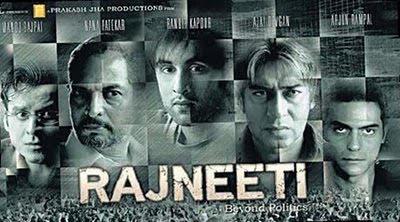
"Rajneeti": It’s for Ranbir only!

There is a famous Bengali proverb: Jaha nei (Maha)bharat e taha nei bharat e. There is nothing in India that has not found mention in the Mahabharata. Therefore, many Indian narratives, if read closely, would reveal some connection with this marvellous epic. One need not deliberately device a plot recalling the epic. Rajneeti as a re-telling of the Mahabharata, therefore, does not appeal in the first place. It would appear in even poorer light to those who have seen Shyam Benegal’s masterpiece Kaliyug. Although Anjum Rajabali, the co-script writer, claims that he has not seen this Benegal magnum opus, the film speaks otherwise. There are actually too many similarities. Benegal’s film based on the story of a business empire split into two had intelligently used tropes from the Mahabharata to apply to a capitalist post-industrial world, establishing the timelessness of myths. But Rajneeti cannot claim such artistic excellence, for one does not really need a conscious revoking of the Mahabharata myth to interpret the current political scenario of India.

What keeps you glued to the chair in Rajneeti is not the story; it’s much too predictable…it’s actually Ranbir Kapoor’s astounding Samar! You witness open-mouthed as this apparently ‘good’ boy pursuing his PhD in “Subtextual Violence in Nineteenth Century Victorian Poetry” in a foreign university graduates cold-bloodedly into a diabolic schemer at the onset of the epical tragedy that overtakes his family’s political career when his father is brutally murdered by his cousin’s men. Ranbir speaks through his eyes; his body language is so articulate that he does not need dialogues. His metamorphosis is so sudden but so believable only because this awesome actor carries off such transformation with an unmatchable aplomb. When he proposes to Indu (Katrina Kaif) he manages to emulate genuine emotions in his voice, although he does not love her. Simultaneously, he also manages to send a shiver down the audience’s spine for he is able to send the message across that he is making this compromise only to win over Indu’s father’s financial support of his party. The undertone of the satanic schemer does not once mar the ingenuous tone of the proposal, but compliment each other. Ranbir takes a very large slice of the cake in the acting department indeed leaving a very small portion for the others to lay claims on.

However, Nana Patekar impresses with his subtle performance. Arjun Rampal has managed to gather a little more than the infamous two-n-a-half expressions that hang on his face all the time. Ajay Devgn and Manoj Bajpai irritate. And Katrina Kaif? Would someone please show her the exit door? She has all kinds of weird expressions on her face which she mistakes as ‘acting’…expressions murderous (literally!) enough to compel you to leave the theatre. Thanks heavens, her presence is rather negligible compared to the huge retinue of male actors. And the hype and hoopla surrounding her Sonia Gandhi act is a wonderfully misleading publicity stunt. She appears in that famous cotton saree for two-n-a-half scenes, much to your relief, of course, and that too at the fag end of the movie. And what acting! O my God! Her eyes and her lips (and whatever comes of it in atrocious Hindi) are so out-of-tune with each other that the scene appears to be one of those American Teleshopping advertisements dubbed in Hindi. All Katrina Kaif films must henceforth carry with them in no ambiguous terms a statutory warning: Watching Katrina Kaif act may be injurious to your psychic well-being. Come at your own risk!

Well, Rajneeti has been declared a box-office hit and the Jha camp is going gaga over it. But it’s not a good film; an average venture in all sense of the term. Due to lack of other solid competitors it has managed to draw the audiences to the theatres, the failure of Ravaan, for example, adding more to its success! I would contend here that Prakash Jha is more in his elements on a smaller canvas. He is a good filmmaker; no two ways about that. But in Rajneeti, under the compulsion of generating a full-fledged entertainer, he had to do away with attention to details. It’s true that Indian politics has undergone a remarkable degeneration, and the film fittingly captures it; but it should have been more specific and individualistic. It seems to be a rather long sweeping statement on the degeneration of politics at large. The director does not even bother to locate the film. The map of the state often shown is a vague simulacrum of the state of Madhya Pradesh. But contemporary cinema has come a long way to be bold enough to be specific about its setting. Had the film been made in some other mode, apart from the realistic one, it could have afforded to be that fuzzy. But not in a realistic mode, no matter how melodramatic it may be! It cannot afford to be “Once upon a time somewhere in India…” story. Nonetheless, it’s a good one-time watch; only blind yourself of Katrina’s catastrophic presence.

Note: I have even chosen a poster without Katrina in it!