Thursday, November 17, 2011

Gangor


Director: Italo Spinelli


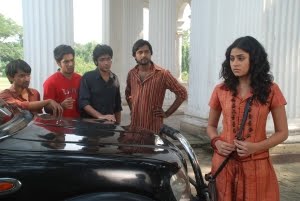
I remember reading Mahasweta Devi’s ‘Choli Ke Pechhe’ (‘Behind the Bodice’) some ten years back, when the memory of the rage this Khalnayak song had stirred up was still quite fresh. It was amazing, and excruciatingly painful, to experience how this Bollywood song was ironically used to bring home the unspeakable plight of a tribal woman. The sexual titillation of the seductively choreographed song with a voluptuous Madhuri Dixit gyrating with occasional bosom-thrusts was frowned upon by the censor board; but the way in which Mahasweta Devi used it gave a complete new meaning to the sensation the song had created. The story not only obliquely questions the shameless parade of female sexuality for public consumption; it also unravels the woman’s vulnerability in a society where beastly sexual hunger for the female body lurks in every corner. Reading Gangor with reference to the hardcore commercial flick Khalnayak is extremely important. While Khalnayak puts the modern day Sita (renamed Ganga) through the fire-test of keeping her chastity inviolate in a defenceless world of lustful men, and makes her emerge victorious, Gangor hammers home the reality of the powerlessness of the woman, doubly marginalized.
However, the Italian-Indian production Gangor, based on the short story, reverses the irony, to some extent, as it were. The story was about how the picture Gangor’s exposed breasts (a journalist from the city captures her feeding her child and publishes the picture in the papers) spells disaster for her; how she is raped multiple times and is transformed into a prostitute. The film has to a great extent ameliorated the grotesqueness of the story, the effect of which was mind-boggling. But, nonetheless, the message is more or less the same. However, the irony is reversed in the sense that the film by literally exposing the bosom of the protagonist cashes in on the same thing it goes out to critique. What a literary text can do without being sexually titillating, the film cannot afford to.
I agree that there wasn’t any pretension in what the director was aiming at. Priyanka Bose, as Gangor, has dropped all inhibition and has believably animated the character. Yet I am sure the film would never be released in India. The censor board would certainly step in and recommend several cuts. The irony is that even when a song like Choli ke Peeche can play uncut on national television with all its licentious suggestiveness which is more objectionable (as regards to the representation of women in films), the ruthless reality of a woman’s sexual vulnerability would come under the censor-scissors.
However, I thank KFF for showcasing this film. I am not sure about its fate, though.

"Meherjaan"

Director: Rubaiyat Hossain


Meherjaan, primarily a love story, is bitingly political; the setting of the film, the 1971 war involving East and West Pakistan, is a terrible historical milieu etched in blood in the collective consciousness of the people on both the sides. The film unearths those painful experiences amidst a lyrical rendition of a beautiful love story.
Meherjaan is saved by a Khan soldier of West Pakistan; and the latter, in turn, is given shelter by the girl. Caught in the dilemma of whether to betray her own nation by falling in love with the enemy, Meherjaan holds her emotion back for a long time. But, she does fall in love eventually: Wasim’s humanitarian world-view that calls into question the grand narrative of aggressive nationalism wins her over. The greater part of the rest of the film is devoted to help Wasim return to his country safely.
While Meherjaan’s personal world unwittingly merges with the political, the war grows more intense with each passing day. A new nation is about to be born, but the political vision of its makers is seriously challenged. Feudalism is soon to be replaced by a new social order that anticipates communism; but, the positive dimensions of feudalism cannot be totally ruled out. An affectionate zamindar, the father-figure of the unnamed village in the interiors of East Pakistan, becomes the principal target of the Peace Committee. Eventually, he is murdered, and the village is set afire. A new country is on the verge of birth, but the bloodbath that precedes it is grotesque.

And, of course, interspersed is the tale of the woman who loses her lover to partisan animosity, and is raped by the soldiers. These tales have been often deliberately evaded by history; nobody has ever bothered to record the trauma and the unspeakable suffering of these women molested brutally during the war. Neela’s daughter born out of rape comes back to Dhaka to research on these women to find very little.
Then there is Salma. Her world is confined to a huge wooden almirah; her fantasies, her dreams and all her idiosyncrasies play themselves out there. She is looking for her knight in shining armour, who, eventually, comes. One good thing is the film, despite the agonies and pains, it portrays is not too awfully dark.
One drawback of the film is that the screenplay is a tad convoluted. It could have been slicker. However, Meherjaan, like Guerrilla, deserves to be released commercially in Kolkata. Bangladesh art-house cinema is certainly going places. It’s time they got wider international recognition.

Friday, October 14, 2011

'Sahib, Biwi aur Gangster': Love, Sex and Politics

Tigmanshu Dhulia transposes Abrar Alvi’s Sahib Biwi aur Gulam (a Guru Dutt production) to contemporary Uttar Pradesh, precisely to the realm of a decadent Raja (Jimmy Shergill as Sahib), unable to outgrow his faded feudal glory and cope up with the rise of the common people, once their subject. Set in the bleak backdrop of dirty politics, Sahib, Biwi aur Gangster is a nerve-racking tale of crime and passion told with a spine-chilling honesty. The film in many ways recalls Vishal Bharadwaj’s classic Maqbool, especially in the love/power nexus in which the three main characters are caught.

Chhoti Rani (Mahie Gill) is way too modern and remarkably less passive compared to Chhoti Bahu of Sahib Biwi aur Gulam. In the game of power that unfolds Chhoti Rani plays a pioneering role that is almost destructive. Enigmatic and whimsical, Chhoti Rani has fallen from grace in Sahib’s eyes for having harbouring amorous feelings for a certain Lalit; the details of the love story, however, is left undisclosed. Under no circumstances is she ready to transgress class boundaries, even though she falls in love all over again with her ex-lover’s namesake, incidentally her chauffer (Randeep Hooda). A clandestine steamy love affair ensues whereby Lalit is ensnared by Chhoti Rani into acting the way she wants him to. Lalit too is no simpleton; madly in love, he throws morality to the winds and embarks on a vicious mission of overthrowing the Sahib and usurping his throne. What he realizes with a fatal blow is that he, despite his cunning and daredevilry, cannot outgrow his class. Class remains central to the narrative; and every human emotion subservient to the necessity of preserving the hierarchy.

The world of Sahib, Biwi Aur Gangster is not very unfamiliar to us. Besides Maqbool, we are also reminded of Anurag Kashyap’s Gulal, one of his finest films till date. In terms of storytelling the film scores the most for it keeps you glued to the screen as endless surprises await you till the end. The film is also worth a watch for the powerhouse of performances it delivers: Randeep Hooda is reinvented as the macho Lalit (alias Babloo); equally credible as a passionate lover and a compulsive evil-doer, Hooda steals the show almost effortlessly. Jimmy Shergill dons the turban of royalty with dignity, and delivers with aplomb. Mahie Gill is good, but needs more experience, it seems.

I am somewhat enjoying this new trend of reworking classics that have crazily caught up with Hindi filmmakers, and interestingly, most of them are doing justice to it. This is a very postmodern phenomenon, which not only offers a reinterpretation of the classics, but also calls into question the sanctimony of authorship and originality. Thanks to the emergence of the multiplexes, again a very late capitalist event, that films such as Sahib, Biwi aur Gangster, are finding producers and of course a doting audience.

Tuesday, October 4, 2011

'Baishey Shrabon': Death of Poetry and a Deadly ‘System’!


It’s extremely difficult to review a thriller, for you often tend to give out the plot, which, of course, is commercially murderous for the film. Srijit Mukherjee’s Baishe Shrabon is primarily a thriller, but it is much more than that. The very title of the film, I believe, underscores the hegemony of the poet who has of late become so literally omnipresent (thanks to the farce the new government has made of him) that all other Bengali poets have been swept into oblivion. Sukanta, Sukumar, Binay, Shakti, Joy Goswami, and others are still esoteric property while Tagore has found access to the popular domain: none can deny Tagore’s superlative potentials as a poet; but this is also irrefutable that a politics of canonization can be discerned in analysing Tagore’s massive popularity and the comparatively lesser recognition the other poets have received. The climactic moment of the film therefore coincides with 'Baishe Shrabon', the day Tagore breathed his last. Interestingly, both Abhijeet and Prabir have to take the assistance of Google to find out the days on which the ‘lesser known’ poets have passed away.


On the other hand, the film is also about the death of poetry. A mad poet, who had set fire to the Calcutta Book Fair for publishers had time and again refused to publish his poetry, is at the centre of the narrative. Baishe Shrabon is different from other thrillers because it is not just about finding out with bated breath ‘whodunit’; it also engages the audience in working out the clue that may be hidden in the poetic lines found in the chits beside every victim. Interestingly, the victims are all from the lowest stratum of society, and the verses found next to them are predominantly proletariat in nature. Although the film does not clarify the choice of such verses, the silence speaks volumes. In fact, there is no criminal in Baishe Shrabon! It is the system! The reference to the anti-Establishment poetic movement (Hungry Movement) of the 60s is of special significance here.


Baishe Shrabon has adroitly blended the esoteric and the populist to a marvellous effect. The handling of the camera, especially in the narrow alleyways of the slum and in the last scene, is simply brilliant. Anupam Ray has not been able to recreate the Autograph magic though. However, Gobhire jao, profoundly rendered by Rupankar, stays with you long after the film is over.


The most promising performance is offered by Parambrata: it is his best, till date. He emotes perfectly, almost flawless; his comic timing is enviable; his accent, recalling his ‘Bengali medium’ background, is awesome. Prasenjit does not disappoint either, as was expected, although the character he plays has affiliation with several suspended police officers we have seen in numerous Hindi films; but, nonetheless, he is good. Raima Sen is effortless and Abir is loveable. The surprise package, however, is Goutam Ghosh. He animates Nibaran Chakraborty with so much life that you do feel your eyes moisten at his death.


Big Cinemas had a considerable number of viewers on Ashtami morning, and that speaks for the success the film is already enjoying. Wishing Baishey Shrabon a long run at the box-office! And a request: Those of you who have already watched the film, please do not give out the end! It does not deserve to be given out, really. People must go and find out for themselves, and believe me, it’s worth it.

Saturday, October 1, 2011

'Rang Milanti': Queen of Hearts: Polyamory to Compulsory Monogamy?


Kaushik Ganguly’s Rang Milanti returns to the age-old theme of the woman’s search for the right mate, vaguely recalling innumerable Bernard Shaw plays, particularly Man and Superman, minus the Shavian concept of the woman’s duty of creating higher beings and preserving them. However, the biological primacy of the woman over the man is certainly assumed. Kamalika is in love with four of her very close friends (Rik, a computer engineer; Tito, an aspiring filmmaker; DJ, a DJ; Laden, a clothes supplier), but cannot make up her mind. Deeply despaired of the separation her sister goes through, Kamalika does not want to take any hasty decision in settling on her partner, lest she too ends up in an unhappy marriage.
The interesting part is that film does not moralise about Kamalika’s polyamorous disposition; rather it approves of it jubilantly. The rest of the film is a delightful journey whereby Kamalika puts her four lovers through a series of tests, assisted by an equally delightful fake psychiatrist, suggestively named Anu Ghatak (which translates into catalyst). Kamalika’s brother-in-law (Saswata Chatterjee in an amazingly fun-filled role), lovingly patronizing as he is, doubles up as the psychiatrist to help her choose the right partner. The ten tests he designs for her lovers have names drawn from film titles: Kapurush Mahapurush (test for bravery), Bajimaat (test for presence of mind), Saheb (test for fluency in English), Father (test for baby-sitting), Kori Diye Kinlam (test for financial standing), Amanush (test for sanity in a drunken state), Ashukh (test for fitness), Abhijaan (test for adventurousness), Apanjan (test for love for family), and Lathi (test for respect for old people). Surprisingly, there is no test for sexual compatibility. Either the assumption is that the woman has no sexual desire, or the director did not have the guts to shock his middle class Bengali audience by making the heroine sleep with all the four lovers. The question of sex arises only when Kamalika has decided upon her partner and is thoroughly disappointed by his approach to sex. Then again, she accepts him for the message is that nobody is perfect. It’s disappointing that sex features last in Kamalika’s search for the ideal partner. The search is interestingly more class-conscious and value-oriented: actually, in order to survive happily in the upper/middle class bracket the woman is compelled to judge her partner on the basis of his social functionality rather than sexual prowess. Therefore, sex takes a backseat in the quest for the ideal mate, and practically so.
The four men surprisingly do not fight over the girl; they rather exhibit an incredible sanity in this whole affair, accepting gladly the girl’s agency in deciding upon her partner. They are too careful not to fall out with each other, notwithstanding who Kamalika eventually chooses. I was wondering when men became so civilized and rational. Ganguly’s men have finally come of age, at least on screen. It’s a tad difficult to believe that none of the four men really protest having to play a remarkably passive role.
The final message is that nobody is perfect, and one has to settle on the best out of this imperfect lot. Kamalika is ultimately not agential in this whole affair of making up her mind for the right partner. Her brother-in-law directs her through this utter confusion: the woman does not get the opportunity to consider her own priorities. Her final choice is conspicuously conditioned by the demands patriarchy makes upon women. Her desire for the right partner is given free play so as not to disrupt an existing social structure. The man eventually wins, all over again.
Nonetheless, Rang Milanti is an amusing watch. It is a fun-filled journey, thanks to Saswata’s amazing performance, Churni’s sophisticated demeanour, Ridhima’s vivacity and the credibility of the four men, Gaurab Chakraborty, Gaurab Chatterjee, Tanaji and Indrashish. Ringo as the snobbish Prakash is also praiseworthy. The music is a downer though. What is after all important is unalloyed entertainment, and Rang Milanti does not disappoint you to that end. A packed Star Theatre on Panchami evening was frequently breaking into splits and cheery claps, and that’s all a director wants.

Friday, August 5, 2011

Iti Mrinalini: Love, Life and…


I was actually expecting to see something like Tennessee Williams’ The Milk Train Doesn’t Stop Here Anymore (1963) as the curtains went up on Iti Mrinalini, the latest Aparna Sen venture. Well, the Williams play and the Aparna Sen film do have similarities; but, of course, I gave up on the comparison much too soon. Any story of a successful commercial actor would have some parameters in common. In fact, Marilyn Monroe’s portrait that hangs in Mrinalini’s (Konkona Sensharma) room and is conspicuously focused on all through the film, speaks volumes to this end.
In a television interview, a few days before the release of the film, Sen said that she has never tried to convey any message through her films consciously; perhaps, no good artiste ever does that. But, somehow, Iti Mrinalini does send out a message, loud and clear; but, without being preachy or didactic, of course. I’ll come back to that later. In fact, not a single message; rather messages.
It’s not very difficult to see why Sen claims that Iti Mrinalini is the most commercial of all her films. Because the film is based on the life of some fictitious mainstream actor of Bengali films of the 1970s, it demanded a commercial treatment, no doubt. But, at the level of the plot too, the commercial aspect is much too evident. Actually too much happens in Mrinalini’s life. In fact, too many tragedies befall her, which, in a way, weaken the plot, as there is a prominent tendency to sentimentalizing. If good cinema refrains from being sentimental, this is definitely a flaw. But, seasoned audience of mainstream Bengali cinema of the 1970s, would be generous enough to give Sen the license to sentimentality; and I am sure I need not explain what I imply here. May be the screen life and the real life of the actor gets curiously mixed up. One may recall the unending series of trials and tribulations, a female protagonist of mainstream Bengali cinema generally underwent in those days, assisting a marvelous exercise of the lachrymose glands of the overly soft-hearted Bengali mothers and aunts (a construct, mind you) who poured into the theatres foregoing their usual afternoon nap. But yes, Sen has nowhere crossed the limits, for her Mrinalini is an apparently strong person.
The film has the structure of a bildungsroman: Mrinalini’s journey from the margins to the center. Although she accomplishes a lot in her professional field, she loses out on the personal front. Actually, more than anything else, Iti Mrinalini, is a love story. It’s the story of a woman who seeks love all through her life; but, it’s not that she doesn’t find any. May be she doesn’t find the kind of love she hankers for. Although Chintan Nair (Kaushik Sen) counsels her saying that she has never realized that love is of different kinds, Mrinalini does not seem convinced. A daughter out of wedlock, a non-committal lover who is inextricably tied to her family and who keeps on telling her that he would come to her one day…Mrinalini does not get the social recognition as a wife or a mother. She acts aunt to her daughter and keeps hoping that Siddhartha (Rajat Kapoor) would legally tie the knot one day. Exasperated she eventually breaks the relationship (“It’s over between us”), but it takes her long to arrive at the realization (assisted by Chintan, of course) that he too might have loved her in his own flawed way. It was love, nonetheless. Chintan becomes her friend, philosopher and guide, and defines for her another kind of love altogether. In fact, it’s a two-word message from him “Ami aschhi” (I am coming) that saves her from taking her life. The ‘message’ is that love may not only happen within socially approved structures of relationships only; love mostly transcends such constrictions. Although Mrinalini seems to accept what Chintan says, her reaction to Imtiaz’s (Priyanshu Chatterjee) betrayal appears a tad too immature. Why does she contemplate suicide? Hasn’t she seen enough so far as not to succumb to such duplicity?
Anyways, the film reaches a different level altogether in the end. Mrinalini is notorious for trying to control everything in her life. In fact, her young daughter calls her a control-freak. When she contemplates suicide, she says that entry on the stage of life was not in her hand, but she can certainly time the exit. But, little did she know that life was more absurd than it appeared to be. When thoughts of death finally desert her, and she goes out to walk her dog with a renewed enthusiasm for life, she is shot dead by a bullet targeting a young boy (Saheb Chattopadhyay) on the run. This very arbitrariness of life which Sen beautifully represents sends a chill down your spine. What you simultaneously realize is that you have come a long way off from the Naxalite 1970s Calcutta to dwell in a city where crime has become the order of the day. It’s difficult to guess who this boy is. But, the doubling of Mrinalini’s boyfriend Abhi does trace a journey of the city and the changing ideology of its young denizens.
I was absolutely overwhelmed by Konkona Senshrama’s mind-blowing performance; Rajat Kapoor does a decent job, and Anjan Dutt’s voice-over matches his personality well. The voice does not seem lent. Kaushik Sen imitates the South Indian accent really well, and delivers with aplomb. Even Saheb Chatterjee gives a believable performance. Kudos to Ananya Banerjee as Sohini, Mrinalini’s daughter. And last, but not the least, Aparna Sen herself. She is as glamorous as ever but she could have been a little more careful in imitating Konkona’s mannerisms.
And, of course, the songs! Am still humming Ajana Kono Golpo…I can’t really get over the magical spell of Bishe Bishe Neel…Debojyoti Mishra has done a fantastic job! The songs would stay on with us forever…and may be enough reason to go back to the theatre.

Tuesday, July 5, 2011

Delhi Belly: Belly-ticklingly boisterous


Delhi Belly is a test in how much you can laugh; in fact, it’s a laugh riot that may stand-in for a 96-minute VLCC abdominal work-out, of course without the perspiration! Your belly would literally undergo so many vibrations, you may emerge from the theatre trimmer than before! Delhi Belly is indubitably the best stress-buster to come in a long time. An adult comedy need not always bank upon double-entendre, slapstick and crass humour to draw the guffaws, and thanks to Aamir Khan, Abhinay Deo and Akshat Verma (the story and scriptwriter), the likes of Golmaal, Double Dhamaal, Dhol, etc. would perhaps run for cover now, out of shame. With Delhi Belly, the adult comedy in Bollywood finally comes of age.
Well, it’s a comedy of errors, and what an error to begin with, I swear! It’s gross, but, nonetheless, hilarious, for the whole thing remains so close to reality. Priceless diamonds get exchanged with dung ‘erroneously’, which in turn gets delivered to the devilish don who, of course, is not particularly pleased. And what follows is a roller-coaster ride of bhaag bhaag that barely gives you the opportunity to recover from your splits! The ensemble cast is a clique of men and women extremely identifiable, only that, they are caught up in a funny situation, which is not particularly funny to any of them, really! I believe that is indeed the hallmark of a good comedy. To add to that, like all good comedies, Delhi Belly does make you think, too. May be afterwards. The show ends in several deaths, break-ups and other unpleasant things underlining the darkness that looms large at the heart (read, belly) of the city.
The film begins with a familiar background score from the late 70s which soon reveals its source: the television at the airport airing a Rishi Kapoor track. This very song acts as an intertextual tool that refers back to the movies of the 70s, where the villains were inevitably smugglers. A clichéd theme is taken, given a make-over, and transmuted into a truly contemporary comedy. The tragic underbelly is however hard not to recognize. Violence, lust, covetousness, opportunism, distrust, blackmail, heartbreak, all these are woven into a rich comic texture, but, with a tragic undertone. The film’s greatness lies in operating on black humour without giving an overwhelming feel of it. Therefore, it’s hard not to laugh, but on second thoughts, the darkness does make its presence felt.
Imran Khan, Kunaal Roy Kapoor, and Vir Das make an awesome threesome! Specially, Kunaal as Nitin is unforgettable, given his believable struggle with an upset tummy through the roller-coaster ride. Vir as Arup is remarkably subtle, sometimes lost, and marvellously funny. Imran Khan is good, but certainly is overshadowed by his two other friends. The quirky Poorna Jagannathan as Maneka is ‘queerly’ loveable, and it’s hard to forget the scene where she shoos away an elderly couple by pretending to ‘ride’ Imran, when the latter gets a real hard-on! Vijay Raaz as the merciless don is full-on entertainment, and I wondered how he did all that with a straight face. Even Shehnaaz Treasury as Sonia performs.
Ram Sampath’s music is another plus. The disappointing thing is that the coolest track of the year Bhaag DK Bose Bhaag only comes in bits and parts, but somehow lends the film its marathon mood. The end credits roll with the extremely funny I hate you (like I love you) with Aamir Khan dressed in a way to remind you of Shotgun Murugan. I have rarely seen the audience sitting through an end-credit song so patiently and enjoying it too. And please note, the T-shirt Imran Khan wears for the greater part of the movie has ‘Stylish Rajnikanth Sunglasses’ written on it on a tag on the left side of his chest. Well, if that too means something to you!

Saturday, May 21, 2011

Noukadubi: With and Beyond Rabindranath


Initially, I was rather apprehensive of Noukadubi (The Boatwreck), for I was rather disappointed with this Tagore novel, for it is perhaps the weakest of his prose-fictions, in terms of plot. The plot turns on too many glaring coincidences, much in the manner of several Dickens or Hardy novels. Again, the later part of the novel where Kamala almost mushily sentimentalizes on her victimization is simply nerve-racking. At times, Noukadubi  seems to read more like a Sarat Chandra novel, than a Tagore novel (However, I am not suggesting that Sarat Chandra’s novels are bad; what I’m trying to imply is that Tagore seems to play to the gallery in a manner akin to Sarat Chandra’s in Noukadubi; and this unsettles the reader, for she opens a Tagore text with a different kind of expectation altogether) Quite bewildered by his choice of text, I was rather curious to see Rituparno Ghosh’s treatment of a story, which originally begins with an interesting twist, but dwindles into dullness. Boatwrecks are famed to wrought havoc, as had been already established by Daniel Defoe's prose romance Robinson Crusoe, and therefore, an fascinating point to begin a narrative. That element of thrill was also there on the first pages of the Tagore novel as well; but, lost wind as the story unfolded. So, I was rather interested to see whether the Rituparno film can sustain the interest! 
I do not really believe that you need to read a novel before going for its cinematic adaptation. But in case of Rituaparno Ghosh’s Noukadubi, I would personally suggest that if you have not read the novel, it would be difficult for you to appreciate the spectacular departures the director makes from the original story. Re-narrating a novel frame by frame on celluloid is not desirable at all; Ghosh steers clear of that brilliantly and very interestingly renders one of Rabindranath’s not-so-good-novels rather watchable. 
What I could not stop marvelling at is the little play on authorship that Rituparno introduces. From the very beginning of the film, Rabindranath enters the narrative as a character whom Hemnalini (Raima Sen) adores, and when asked by Annada, her father (Dhritiman Chatterjee) whether she has developed amorous interest in someone, she says that her obvious choice is the poet. Next, Ramesh (Jishu Sengupta) while shifting to his new house and setting it up, admits that Rabindranath has become an indispensable part of his reality and demands a special corner in his house. I guess he even uses the word bojha (or burden) that the cultural phenomenon called Rabindarnath Thakur has become in the educated middle class Bengali household. The picture of the poet is used quite frequently; particularly the positioning of the picture in the scene where Nalikakshya (Prasenjit Chatterjee) sings Tori amar hothath dubey jai (My canoe sinks all of a sudden) is rather suggestive. The camera moves from Nalikakshya seated on one side of the room to a tearful Hemnalini sitting on the other side. The picture sits royally in-between the two, almost, overseeing, as it were, the proceedings. While he is the primary inspiration behind the story we see on celluloid, the director good-humouredly calls into question the very sanctity of his authorship by moulding the existing text to serve his cinematic purposes, right under his nose, as it were. This in turn deconstructs the whole notion of author-as-God, and also perhaps rescues Rabindranath from the unquestionable divine status many have attributed to the poet. Ironically, the picture is shown to be ritualistically worshipped. The introduction of this picture leaves you wondering endlessly what happens when the author himself finds access into his own fictional world. Then again, whose fictional world is this? Rituparno’s or Rabindranath’s? In fact, when the film ends, you realize the significance of the song Khelghar bandhte legechhi (I have begun building a doll’s house brick by brick) with which the film begins. The word khela translates into ‘play’; the suggestion is the director too is all set to begin a ‘play’ (please note play may mean both ‘game’ and ‘drama’) with a Tagore text; he is constructing a little drama, in the spirit of ‘play’, where he enters into a dialogue with the original author of Noukadubi. In this sense Khelaghar bandhte legechhi almost functions as a preface to the film.
The Bhawal-Sanyasi case forms the subtext of the film and quite understandably so; Shakuntala too is an important inter-text. The story of the wife’s predicament when she finds that her husband has completely lost all memories of her acts as an elaborate dramatic irony in Kamala’s (Riya Sen) narrative. In one occasion there is a delightful reference to Tennyson as well. In the novel both Ramesh and Akshaye gift the same hard-bound copy of Tennyson to Hemnalini. The suggestion could be that Tennyson, the pioneer of mainstream Victorianism, was an important vehicle of cultural colonization in colonial Bengal. One may recall in ‘The Lady of Shallot’, there appears a couple walking hand-in-hand in the moonlit night, when Tennyson almost with a sense of urgency quickly adds that they are lately married. Love or sex outside wedlock was regarded sacrilegious by the Victorian moral police. Therefore, Tennyson as a gift resonates with political implications. Ironically, however, the very inviolability of the institution of marriage is sufficiently challenged by the novel (and the film).
The use of Rabindrasangeet is extremely intelligent and the songs selected meaningfully contribute to the plot. Khelaghar bandhte legechhi amar moner bhitore (In the core of my heart, I have begun building a doll’s house brick by brick) with which the film begins acts a dramatic irony introducing Hemnalini’s vulnerability in love. The heart-rending Tori amar hothat dubey jaye literally takes on the title, while adequately expressing the misgivings of estrangement. Tomar ashimey (In the eternity that you are) comes at the right moment when a lovelorn Hemnalini fights with herself to come to terms with her reality. And all ends well with Anandalok e mangalaloke birajo satya sundar!
I feel that Noukadubi demands to be appreciated not only on the level of the narrative, but in terms of its execution. Since I was sceptical of the novel per se, the film came to me a pleasant surprise. And yes, once again, Rituparno Ghosh has proved he can really make his actors act: Raima is believable, and Jishu is sublte; but Prasenjit disappoints to a certain extent. He fails to bring into his performance the gravity Nalinakshya’s character demands. The astonishing part is that Riya Sen has actually acted; but, I feel, the lion’s share of the praise which Riya would command, should go to Monali Thakur whose voice-over has miraculously accentuated her performance.
An enjoyable film, Noukadubi could have gained a little more complexity had Ghosh shown a developing physical relationship between Kamala and Ramesh before the latter comes to discover Kamala’s real identity. The novel had given clear indications of that. But for some unknown reason Rituparno has refrained from it. But that does not take away from the film its brilliance.

Tuesday, April 19, 2011

The King Must ‘Perform’!

Tom Hooper’s The King’s Speech is apparently a heart-warming tale of how King George VI overcomes his speech impediment with the assistance of an Australian speech therapist Lionel Logue. But the film has larger political implications: it is not just about conquering a disability, it is also about the public role of the King, and that too the British King in the 1930s who must put up a majestic performance on the world stage, a performance that would have well-meaning impact not only in England but the numerous colonies to which he was the ultimate symbol of power.

The film at one level offers a common man’s story, the Duke of York (who later becomes George VI) stripped of the royal aura that circumscribes him; at another level, it unravels the pressures of becoming the King of England, the obligation of performing as a King must conventionally perform so as to keep inviolate the notion of the Protector and perhaps also the hallowed image God’s anointed  and appointed representative on Earth. In the face of the Nazi uprising in Germany, on the eve of World War II, the King cannot afford not to perform according to the expectations of his millions of subjects scattered across the globe. The personal and the political come into a major conflict which the King must resolve. He must overcome his speech impediment or tarnish his kingly image irredeemably. The film captures the psychological struggle of the disabled King with remarkable intensity without being preachy. Colin Firth carries off the role with panache and so much credibility that you fall in love with him.

It’s a story of the marginalized, ironically indeed. The King of England and marginal? The sublimity of The King’s Speech perhaps lies in its making this absolutely credible. The King is stripped off the aura that makes him King and the film imagines his private life with amazing sincerity. While probing into the psychological roots that may be the cause of the fumble, Lionel discovers how the young prince was forced to give up his left-handedness; how he suffered the painful treatment for his knock-knees; how his nanny hated him and pinched him in the presence of his parents so that he wailed to the disgruntlement of the latter. From early childhood, he was thrust into role-playing, and no form of disability or unconventional behaviour was encouraged in him; in fact, was mercilessly repressed. Here the King’s tale coincides with that of any unfortunate child who has gone through traumatic experiences for not being ‘normal’. This is exactly where the audience connects with the King’s story, and partakes his grief.

David Seidler’s screenplay which is a product of several years’ serious research is near flawless. However, the ensemble cast is perhaps something one should look forward to. Geoffrey Rush as the unrelenting speech therapist with an excellent sense of humour is a treat. Helena Bonham Carter as the King’s wife (I would not say queen and you would know why when you watch the film) is marvellous. She shares her husband’s insecurities with so much affection that she almost unknowingly ends up playing a caring mother to a helpless child. The rest of the cast is equally believable.

The King’s Speech is a must watch; it takes you within the walls of the imposing Buckingham Palace and reveals to you the emotional odyssey of a man beyond the grandiloquent mask of Your Highness that he wears and how!

Saturday, April 2, 2011

Memories in March: Bonding and Beyond

Aar Ekti Premer Golpo has paved the path for the issue of alternative sexuality find access to the arena of popular Bengali cinema. But Bengali cinema is yet to come of age when in comes to representing alternative sexuality; for, it’s high time that queerness was rescued from being an issue and represented as ‘normal’. Whether it’s Aar Ekti Premer Golpo or the present film Memories in March (Dir: Sanjay Nag), the endeavour to ‘normalize’ queerness is more than honest; but the very fact that it’s an ‘issue’ is something none of these films have been able to transcend. Perhaps, because Bengali cinema is still at a very immature stage of representing queerness, that it tends to get preachy documentary-style whenever queerness is discussed. Therefore when a disconcerted Mrs. Mishra (Deepti Naval) innocently asks Ornab (Rituparno Ghosh) that whether her negligence or her inability to spend quality time with her son Siddharth has anything to do with the ‘abnormality’ in him, Ornab is infuriated and tells her to have herself examined by a psychiatrist. Bengali cinema is still at a stage when a queer relationship cannot be represented like any other heterosexual relationship without the weighty baggage of justification. Many would argue the very concept of being queer is rather ‘new’ to India; in fact, the heteronormative/queer binary has entered the popular consciousness of the country after the economic liberalization in the early 90s. Therefore, it is impossible not to address the question of associating abnormality with queerness even at this stage. But I believe that queer cinema comes of age only when it represents same-sex relationships as natural, and not as something deviant which demands to be integrated into the mainstream. Memories in March has failed to achieve that maturity.

Coming to the film proper: Memories in March is not a merely a film about a gay relationship; it is something more than that. In fact, like many other Rituparno Ghosh films, it is about human bonding, about the genesis of new relationships between strangers despite apparent differences. However, things seem to happen too fast. Mrs. Mishra arrives in Kolkata to collect the ashes of her deceased son when she shockingly discovers that he was gay. She learns from Shahana (Raima Sen) that he was in a relationship with his boss Ornab, whom she accuses of having seduced her son. Ornab loses his cool and enters into a verbal tirade with Mrs. Mishra which ends in an emotional calamity. However, Mrs. Mishra gradually comes to terms with her son’s being gay and accepts Ornab and the fact of his being an integral part of her son’s life.

What strikes us as unnatural is how amazingly composed the characters are! Be it Ornab, be it Shahana, or be it the bereaved mother herself − all of them a remarkably controlled. Although Ornab breaks into tears sitting in the car at the place of the accident, the way he dresses up the very next day in office does not carry any mark of what he is going through. Shahana claims to be in love with Siddharth; but she too is exceptionally unperturbed. Mrs. Mishra too seems to rise above the trauma much too soon. Perhaps none of the characters believe in public display of private emotions. But somehow Siddharth’s sudden death does not seem to be a harrowing affair. There’s too much of an economy of emotions which at times appears incredible. However, I must admit that the songs penned by Rituparno Ghosh with their melancholy notes compensate for the emotions that seem to be lacking.

The film may appear a bit stifling for most of it happens in a poorly-lit apartment; perhaps the apartment contributes to the dark mood of the film, but somehow it appears a tad claustrophobic. Even the rains which come in the end only slant into the balcony of the flat drenching the clay ash-container. Besides that, too many television-style close-ups grate on the nerves at times; there’s barely a long shot in the entire film. Sometimes it seems that you are watching a telefilm.

Veteran actor Deepti Naval is simply outstanding; she is never over-the-top. Although remarkably composed, her eyes speak volumes. She does not act; she behaves and that too with an amazing dignity that suits her personality to a T. Rituparno Ghosh was comparatively better in Aar Ekti Premer Golpo; however, he tries his best to deliver. But his English is slightly strained. Raima Sen is extremely unimpressive as Shahana, although expectations were higher this time.

Memories in March is nonetheless sensible and demands a one-time watch at least. And let me tell you it does not appear to be a Rituparno Ghosh film as many had anticipated it would. Although the look-and-feel is reminiscent of many a Ghosh flick, none can deny that it has been made by someone else. It’s a Sanjay Nag film, after all. Despite Ghosh’s script, it certainly lacks the fine emotional touch that is the hallmark of an out-and-out Ghosh film.

N.B: I have one fear though: Rituparno Ghosh should not become the face of gayness per se. All gay people are not like Rituparno Ghosh. Perhaps this could have been better established had the film shown Siddharth over whom girls too used to drool and with whom Shahana fell in love, head-over-heels. That too would have contributed to breaking the stereotype even more!

Saturday, January 29, 2011

'Dhobi Ghat': Intertwined lives and a city

In his non-fiction narrative on Bombay, Maximum City: Bombay Lost and Found, Suketu Mehta writes:

If you are late for work in Bombay, and reach the station just as the train is leaving the platform, you can run up to the packed compartments and you will find many hands stretching out to grab you on board, unfolding outward from the train like petals.
 Kiran Rao captures through her lenses a Bombay which generates a new meaning for everyone who visits the city. What Arun (Aamir Khan) feels about the city ---“Mumbai my muse, my whore, my beloved’ ----- is Kiran’s feelings too, or else she could not have shot Bombay so romantically, yet realistically. The film opens on the rain-drenched Marine Drive through Yasmine’s (Kriti Malhotra) amateurishly held video-camera, and soon moves to other people and other stories inextricably connected with each other. Arun’s painting exhibition is a tribute to all the people coming from different states of the country, people who have made Bombay what it is today. Arun makes a dig at those whose political agenda is to officially provincialize the city. The film cutting across class and community borders is actually an answer to the drive towards such provincialization.

Shai (Monica Dogra) who flies to the city from New York on a sabbatical falls in love with Arun, while the slum-dweller washer-boy Munna (Prateik Babbar) gradually falls in love with her. The film effortlessly moves amongst the world of art, the dark underworld of the city, the posh high-rises and cramped slums, and breathes into the city the freshness of the sea breeze and the infinite mystery of the ocean itself, the mystery of how human relationships are sustained overcoming so many differences.

Arun’s discovery of Yasmine’s video-tapes reveals for him a new perspective of looking at the city. Yasmine, the newly-wed girl from Uttar Pradesh, captures every nook and cranny of the city, every single activity that forms a part of her Bombay life to send to her brother Imran in the village. Arun starts living Yasmine’s life through the tapes and is absolutely shattered when he conjectures that Yasmine had taken her own life in the very room where her videos have been playing day and night.

Pratieik’s dhobi is perfect in body language and in dialogue delivery. His awareness of his class when he visits his customers, his shyness when Shai offers him to be her city-guide and when he gradually falls in love with her, and his anger at his brother’s murder − all these emotions are in the right place. He doesn’t act, but behave. The same is true of Monica Dogra and Kriti Malhotra.

The camera within the camera technique is simply brilliant, for often you do not realize whose narrative you are listening to (read watching)? Is it Yasmine’s or is it the omniscient director’s? Tushar Kanti Ray has done a commendable job! Gustavo Santaolalla’s background score is so very much in tune with the scenes, that you barely recognize it as background score separately.

Lastly, a good piece of art is many things roped into one.. But quite significantly it reestablishes faith in the essential goodness of human beings. Perhaps this is what Dhobi Ghat does and how! A single visit to this ghat is not enough…you would feel like going back.

Friday, December 24, 2010

'Aar Ekti Premer Golpo': Shall we say ‘a good start’?

Rituparno Ghosh’s Roop asks Indraneil Sengupta’s Basu if they are invited to appear at the Habitat together at the same time when his pregnant wife Rani (Churni Ganguly) wishes to go out for biriyani at Karim’s, who is he going to choose. Basu does not have an answer; in fact, he cannot have. For, both Roop and Rani are equally important and indispensable to him. Kaushik Ganguly captures with subtlety the tragedy of the bisexual man who oscillates and exhausts himself in maintaining the balancing act between his wife and boyfriend. While the whole world has labeled Aar Ekti Premer Golpo as the first Bengali ‘gay’ feature film, and in its review seems to tilt more towards delineating the vulnerability of the films two gay characters − Roop, the film director and Chapal Bhaduri, the veteran folk theatre actor, the vulnerability of Basu, the bisexual cinematographer is almost elided, as if he did not exist. What is remarkable is that the film does not stereotype Roop’s lover as exploitative or manipulative, but sensitively handles his character which, commendably enough, does not verge on the perverse. Basu’s tragedy is that he is caught between two relationships, one, socially approved, the other not; but the emotional quotient involved in both is equal. The last scene where Roop and Basu kiss and cry before they separate the reality of this in-between-ness and the very impossibility of finding a remedy to it becomes all the more conspicuous; and perhaps, it is here the film scores the most, notwithstanding its sensitive handling of the homosexual men as well.

So, let’s not call Aar Ekti Premer Golpo, a gay love story; let’s be a little more term-sensitive, and call it, a queer love story. However, the irony is, while the title of the film makes a laudable endeavour to dispense of with the sexual identity of its protagonists (underscored by the words aar ekti translated as ‘just another’), terms such as ‘gay’, ‘bisexual’, or ‘queer’ cannot be done away with in interpreting the film. At one point Roop is questioned by a media-person whether the focus of his film is on Chapal Bhaduri’s sexual life; he annoyingly retorts that had he been making a film on Amitabh Bachchan, would he have asked him the same question. Do we refer to say, You’ve Got Mail or say Saptapadi as a heterosexual or straight love story? We don’t. But in case of a film dealing with same-sex relationships say, Brokeback Mountain, some branding such as ‘gay’, ‘lesbian’ or ‘bisexual’ is found almost indispensable. Can we stop being queer or feminist, and just be humanist? Perhaps labeling is indeed necessary to advance an identity politics in a world which is essentially sympathetic only to heteronormativity. The debate may continue endlessly, as to whether labeling of alternative sexual inclinations is necessary or not, but I am going to leave it to that, and turn on Aar Ekti Premer Golpo as of now.

Roop, the self-proclaimed liberated gay film director from Delhi who effortlessly cross-dresses and is very assertive about it, is, in a way, the alter-ego of Chapal Rani, the yesteryear folk-theatre actor of Bengal, who impersonated female characters on stage. At one point in the film, Momo (Raima Sen) tells Basu that Roop is using the story of Chapal Rani’s life as a peg to hang his own story. Such an observation, though refuted by Basu, is, I feel, true; for, Chapal Bhaduri has all of a sudden drawn much attention from filmmakers and cultural commentators in the wake of LGBTQ studies becoming ‘fashionable’ in India. He has, almost overnight, graduated into an object of study, owing to his sexual fluidity. Then again, his story is also needed to be told, and yes, the focus is severely upon his sexual life. No matter how vehemently Roop denies (in a penchant to be politically correct) that he would not highlight the actor’s sexuality, he ends up, childishly demanding Chapal Rani to be honest with his sexual life. The ambivalence in Roop becomes most palpable if one juxtaposes two scenes:

(1) At the very beginning of the film, Roop compassionately tells Chapal to stop telling his tale if he finds it very painful.

(2) In the end, Roop flares up with anger when Chapal refuses to expose some very private details of his life.


The undercurrent of exploitation is there, no matter, how much Roop and Chapal Bhaduri connect with each other. Or shall we say, queer people do hunt out stories (and it is necessary) that reflect their own lives in order to empower the rebellion against heteronormativity?

What is interesting is that, though Roop may appear as Chapal’s alter ego in the film (an observation that is strengthened by the film-with-the-film), both are different. While Chapal feels like a woman trapped within a man’s body, Roop celebrates his sexual fluidity. Both are gay, but not in the same way. Besides, locating the characters in history is also very important. The reality of having alternative sexual inclinations is not same for an English-educated, financially liberated, urban film director of the new millennium and a closeted, uneducated, economically handicapped folk-theatre actor of rural Bengal. Momo is right when she says that although Roop doesn’t admit to himself, he is as closeted as Chapal deep within. But superficially at least, Roop is considerably liberated, although he, like Chapal, remains lonely till the end.

Some of my friends were skeptical that the film might end up leaving the wrong message that gay people are essentially effeminate and are always victimized. The suggestive gayness in Jisshu Sengupta’s Uday who gradually falls in love with Roop perhaps saves the film from reasserting the stereotype. Many queer activists might find ridiculous how a young Chapal is always inclined to emulate heterosexual marital bonds in his relationship with his lovers. He cooks, washes clothes, looks after the house and the kids, and acts passive in bed. But it should be borne in mind Chapal could not have been otherwise, given his spatio-temporal location, and his lack of ‘community’.

Rituparno Ghosh’s acting debut is just about okay; someone younger could have been better, perhaps. Indraneil Sengupta is as usual mind-blowing, especially in the film-with-the-film. Jisshu Sengupta with a characteristic nonchalance would definitely take the cake. Raima Sen with her sheer effortlessness is gradually emerging as a good actor. Churni is fantastic as paraplegic in the film-with-the-film.

Aar Ekti Premer Golpo is definitely a good start; though not iconoclastic in the true sense of the term, it does open up new avenues for future directors to experiment on the same lines.


PS: The scene where Chapal and the paraplegic Gopa dance to Pran bhoriye trisha bhoriye would stay with you forever.

Saturday, December 18, 2010

"Moner Manush": Where’s this Arshinagar?

None can deny the indispensability of Lalan Fakir today. In the wake of communal violence that is ripping and tearing our country into uncountable pieces, Lalan’s philosophy of life and his world-view seem all the more relevant. While the Bengal Renaissance was bringing about unprecedented cultural transformation in the city, Lalan with his simplistic songs had brought in a revolution in the remote villages of Bangladesh, invalidating the caste-system and calling into question communal differences, especially between Hindus and Muslims, the two religious communities operating almost as binary opposites in the cultural consciousness of Bangladesh. Born into an orthodox Hindu family, and rescued and rejuvenated by a Muslim woman, Lalan graduated into a visionary who could not differentiate between communities. His utopian village in the heart of the forest turned out to be the Arshinagar (city of mirrors) of his song, where communal and gender differences were dissolved into an Anandabazar. However, his quest for Moner Manush (the man of the soul) continued till the very end of his life. It’s a union all great poets have always craved for, but have always felt a few yards short of achieving it: Milan hobe koto dine, amar moner manusher sone? was to be soon complemented by the heart-rending melody of Dariye achho tumi amar gaaner oparey/Amar sur guli paye charan, ami pai ne tomare…


Goutam Ghosh’s choice of subject is indeed remarkable. Sunil Gangopadhyay’s novel (or shall I say biopic?) on Lalan Fakir’s life, if read and understood, can act as a remedy to the contemporary disease of communal fundamentalism and associated violence from which our country has still not found respite. Structured like a bildungsroman (it may also be read as a kuntsleroman), the film traces Lalan’s journey from a simple village boy to a cultural icon of colonial Bengal. Because films are audio-visual, a lot could be said without the use of dialogues. The biggest flaw of the film is that more is told than shown, although the director’s expertise as a cinematographer shows itself in every single frame. Sticking too close to the written narrative, at 160 minutes the film seems to be testing your patience. Had it been a good 40 minutes shorter, Moner Manush would have been a classic piece of cinema. Sometimes, the film resorts to didacticism: the ‘preachiness’ of the dialogues could have been avoided by a smarter script. For instance, when Lalan comes back to his family as a Fakir, the conservative Hindu mother and his wife face a terrible crisis. They can neither give up on him, nor give up their jaat, for he has been nurtured by a Muslim family. The scene could have been made poignant had less been said; the pathos of the scene is totally marred by the in-your-face dialogues on caste and religion.


I am not too happy with Prasenjit’s performance; but, I do admit, he has tried to give his best. The vocal intonations were quite forced, and the voice-over (the songs) did not quite match with Prasenjit’s original voice. Paoli Dam is average, and looks funny in her first song, where she appears more like a lifeless puppet who dances as some unseen string is maneuvered from somewhere to help her make the moves. Indeed, the acting department is awfully poor. The songs are good, but not always used at the right sequence. The cinematography, as I already mentioned, is brilliant…the verdure green, the blue rivers of Bangladesh are brought to life by the camera that caresses them affectionately.


On the whole, Moner Manush is not bad; good for a one-time watch. But it does not leave any indelible impression as the expectation had been. No matter, how very much the Bengali film industry is raving about it, do not trust them. Or else, you would be disappointed. For, the film has not been able to leave the aftertaste of having truly visited Arshinagar.

Tuesday, December 7, 2010

The Varanasi Blast

I could not imagine myself ranting about a blast that apparently blew up the Ganga-aarti on Sitala Ghat in Varanasi about which I was going gaga even a week ago. Today’s newspaper headline left me practically paralyzed. Who engineered the blast is not important to me, but what plagues me is the utter intolerance that is prevailing unmitigated in our country. The papers are juxtaposing the 2006 blast in Varanasi and the 1992 Babri Masjid demolition with yesterday’s terrorist attack in order to place this blast in history. Such an attempt is a painful reminder of several unspeakable incidents of communal violence that have torned our country asunder and have left deep incurable scars on our souls. No communal violence can be treated as an isolated affair; and I am inevitably reminded of Paul R. Brass who observes: “It is not possible to develop a casual theory of ethnic riots separate from the discusses which encompass them free from the pressures of the prevailing ideologies and social scientific paradigms and the master narrative into which they are so often placed” (Riots and Pogroms, p.11).

Every time these terror attacks, these ethnic riots take innocent lives, I wonder whether we are not too far away from regressing into complete barbarism. The irony of our hi-tech society is that the more we have advanced technological, the more reactionary have we become in terms of humanitarianism. If “eye for an eye” is the philosophy which rules the worldview of several ethnic groups that constitute this nation, the very idea of the Indian nation would collapse very soon, if it practically hasn’t already. Let’s delete such terms as democracy, republic, etc. from our constitution, which barely have anything to do with our present-day reality. The grand narrative of nationalism has already seen its demise in the wake of global postmodernism…only that, we are learning it the hard way. This is, however, not to suggest that any alternative to the democratic framework of the nation is desirable; we do not want India to emulate Burma or Sri Lanka. But what lies ahead is utter darkness. I feel sorry for myself that I cannot afford to be optimistic any more. Is there anyone out there who can see a silver lining anywhere on the fringes of this dark dismal cloud that has covered us?

Friday, November 12, 2010

Varansi: What's not so holy about it!


Well…my nine-day work and play in India’s supposedly holiest city has left me craving for Dettol which would have turned into an Obsessive Compulsive Disorder had I stayed there for even a week more! My heart had already filled with misgivings the moment I had stepped on the platform which, incidentally turned out to be abnormally shorter than the length of the train, causing us to jump and tripping over our luggage which we had literally thrown down beside the track. This was followed by the usual hazards of finding the right kind of transport, and once it was eventually found, we were ushered into pandemonium as it were. Milton would have certainly found more epic similes appropriate to describe hell, had he ever experienced the Varanasi traffic. There were barely any signals, and almost no traffic police (the one we saw at a crossing was busy checking out clothes on the roadside stand), and what we witnessed on the streets was ten times less disciplined than the post-Tsunami chaos one encountered in the South Asian islands. Thankfully there were no buses; the smaller vehicles bumped into each other, rubbed against each other, shoved people (and the ubiquitous oxen) out of their way, yet, nobody complained, as if, chaos was the order! And I better not talk about the pedestrian! I found it difficult to apply even ‘downmarket’ to them; that was discovered to be a serious understatement. In fact, there are no adjectives in the English dictionary to sufficiently describe the crowd which famously or infamously resembled our Canning/Diamond Harbour counterpart. Arrrrrrrrrrrrrgh! What struck me in the midst of the chaos was that the city was terribly dirty! I doubt whether there is at all any sanitary system, or may be a different meaning of sanitation is in vogue there! By the time we reached our hotel, we were imagining dirt trickling down our bodies, which no ablution ceremony could purge.


The Dashwamedh Road, where we stayed, could even give our Chandni Chowk a run for its money, for a never-ending stream of humanity floated over it, as perennially as the Ganga herself. And this part of the city was a curious mixture of tradition and modernity! Signs of globalization existed side by side with the past which made itself heard rather stridently. Global travellers strolled on the streets taking in the chaotic oriental holiness, overwhelmed by the spirituality which was rather palpable. The Kashi Viswhanath Temple and the Annapurna Temple were only two of the several holy abodes that housed around 84 lakh gods and goddesses of the Hindu pantheon. Spirituality was literally in the air, but depressingly undercut by a feeling of nausea that never seemed to desert me. The only time, I felt sufficiently removed from the calamity that reigned was at the time of the Ganga-Aarti, a ritualistic performance with several props. Holy songs accompanied the dance-like movements of the priests (might not be priests, actually) who carefully performed the Aarti in remarkable harmony with each other in front of an awestruck audience. The scene appeared heavenly from the boat floating on the river.


The famous alleyways were remarkably adventurous, giving you the feel of getting lost in a maze, with old intimidating houses augmenting the feeling of claustrophobia with every step that was taken. You would be invariably reminded of Jatayu who had felt that every single house lining the alleyways was haunted. Yes, true enough! They were haunted by the past, overburdened by the histories they carried with them. In certain places, it seemed as if history was caught in a time-warp and had not been allowed to flow on. And as we took the boat-ride, we were taken back in time, for the scene on the shore appeared to belong to another era altogether. In the boatman’s narrative myth and history effortlessly slipped into each other: it was difficult to filter out myth from history. While it seemed that this journey had brought us closer to the mythological figures of Shiva, Parvati or such epic characters like Rama and Sita, we also seemed to be in dialogue with such recent historical figures like Munshi Premchand. The feeling that time had flown uninterrupted with the perennially flowing river made us feel a ripple flowing down the spine…! We too were an important part in the everlasting river of human history.


P.S: The cuisine: if you cannot do without non-veg, well, Varanasi is not a place for you. But, if you know how to spot the right eating-place, then, even veg dishes could be mouth-watering. We doted on Shree Café, behind the Dashwamedh Lodge, which we accidentally discovered for the restaurant recommended to us was closed. Punjabi, Chinese and Israeli dishes that comprised the menu were marvellous. My insatiable lust for flesh (read chicken, mutton, etc) was to a great extent appeased by the food Shree Café served. And then, there were traditional Varanasi items to taste. First, rabri and then, of course, a huge spectrum of sweets. Although, I am not too much of a sweet-person, I could not really resist the temptation of tasting a few. The rabri was awesome, and it’s a different experience to have it while it was being made. And not to forget the kauchoris and samosas! I believe Varanasi is perhaps most traditional here: the people are simply not bothered about calorie-gain! No matter how many global clothes the roadside stands that have gobbled up half the roads display, the food habit seems to have remained unchanged!


Sunday, October 31, 2010

Two recent television ads and ‘gay’ sites of sexual ambivalence

Still from the Wild Stone Ad
The Wild Stone Talc for Men ad pleads with the men: DO NOT SMELL LIKE A WOMAN…SMELL LIKE A MAN. The very constructed nature of gender becomes more than apparent in the plea. The ad begins with images of men who the hypermasculine voice-over (speaking grammatically incorrect English) points out as effeminate and therefore ‘wrong’: a man with long hair, a metrosexual man in a parlour and an overweight man who cries and expresses joy in an effeminate way. However, in the ad, the male body is offered as an object of desire; the man, so far used to using women’s talcum powder makes seductive ‘feminine’ gestures…his muscular body does not quite match with his ‘imposed’ effeminate movements (this is made clearly evident)…thereby underlining the gap between masculinity associated with a well-built body and effeminacy which is ‘other’ to the muscular body. The simple equation that is thereby generated between the muscular body and manliness in turn generates an essentialization of the structure of the body and sexual behaviouralism. This essentialization is dangerous and unfortunately enough this has entered the popular consciousness. In fact, this notion by extension misinterprets effeminacy as gayness in most cases. (Also note the man in the ad is wearing baby pink) That there is no absolute connection between homosexuality and effeminacy is barely focussed upon in popular culture. As a result, incorrect ideas about masculinity, homosexuality, etc continue to circulate and get embedded in the popular unconscious.

However, the question of gaze becomes important here. Who does the camera assume as audience? Certainly, it intends to draw a loathsome reaction from the homophobic crowd, both male and female or those who do not believe in sexual ambivalence. But, by exhibiting the male body as spectacle doesn’t it also open up space to accommodate the heterosexual female as well as gay, bisexual and transsexual audiences as well?

A still from the Pepsi Ad
The second ad I would like to draw attention to is the latest Pepsi Youngistan ad featuring Ranbir Kapoor. The situation is rather funny: a guy has come to see a girl, and Pepsi is served; a marriage negotiation is on the cards. The girl is rather reluctant to marry. Suddenly Ranbir materializes from nowhere and kisses the would-be-groom on the cheeks. The guy is flabbergasted, the parents shocked, and the girl is delighted. The guy really does not know Ranbir and he says so; immediately another guy materializes from an adjacent room and asks the would-be-groom sadly whether he would also deny knowing him. The negotiation is broken off immediately and the girl thanks the boys for the drama. But they say they are there for the Pepsi; not to help her.

The little drama that Ranbir conjures up is surprisingly without any hidden mockery at gayness per se. The theme of the ad is totally in tune with the pranks Ranbir is usually seen to play on others in these ads with a characteristic naughtiness. Somehow one is bound to feel that after all some kind of naturalness is attributed to the possibility of homosexual affairs. However, the appearance of the second guy who also claims to be in a relationship with the would-be-groom underscores the polygamous nature of homosexual people. This is a kind of essentialization, no doubt. But, in a way, it also underscores the positive possibility of being in more than one relationship at the same time. The morality associated with heterosexual marriage and monogamy is overturned very subtly. However, the interpretation of this may vary. Some may look upon the introduction of the second guy as a disapproving commentary on the promiscuous nature of gay men. However, this may be read down by drawing attention to the fact that Youngistan wants more and still more…their desires are insatiable. Such desire is not only confined to the material realm of gadgets, food or fashion, but also effortlessly extends to the emotional world. So promiscuity or multiple affairs have become the order of the day, and are not specific only to same-sex relationships.

Thursday, October 21, 2010

"Autograph": Signature of Love

The film sets in to usher you into wondering how many narrative frames are actually at work. It’s not confusing, but thrilling to note that the extra-diegetic circumstances leading to the making of Autograph itself may be at work here: I mean, a debutant director approaching a veteran actor to do his film. Is Subho (Indraneil Sengupta), Srijit Mukherjee himself? Are the initial scenes a direct one-on-one take on what happened in real life? And, then, there’s this film within the film. So, what you have is a Chinese box narrative, facilitating a complex layering that does not confuse but please with all its intricacies.


Intertextuality is a trope that is ardently adopted by postmodern artists, for no work of art can claim to be original. Either overtly or covertly, subtexts of already written texts are present in every work of art is produced, and therefore, the heavy subtext of Nayak that underlies (or overlies, perhaps) Autograph fascinate as the audience is sort of engaged almost compulsively into a mind game whereby he/she delightfully recognizes the similarities with the Ray classic and of course, the departures from them. What is praiseworthy is that despite being ambitious (the ambition being as monumental as remaking Nayak), the film is completely unpretentious and somewhat humble in its treatment of the subject. Srijit Mukherjee would never invite the kind of criticism that Sanjay Leela Bhansali had to face in his attempt to remake Devdas; for very intelligently this debutant director somehow does not leave any space for comparison. Autograph is a new film, in the true sense of the term.


The love that blossoms between Arun (Prosenjit Chatterjee) and Srinandita (Nandana Deb Sen) is something that we had desirously expected to bud between the debonair Uttam Kumar and the coy Sharmila Tagore in Nayak. The suggestion of a developing soft corner was there, but that never matured. Autograph sort of compeletes, yet leaves incomplete that seemingly infinitely postponed romance in the beautiful emotional drama that shapes up involving the veteran actor and the debutant heroine. The film does send out a moral lesson, but so subtly that if you are not to alert you may just miss out on it. Subho’s transformation is the key to the moral: juxtapose the two scenes: Subho smilingly putting a coin on the beggar-boy’s plate and Subho rolling up the cab window as the beggar-boy expectantly peers in, towards the end of the film. Nothing great apparently: but do note Indraneil Sengupta’s expressions in both scenes. Mute, but they speak volumes. Indraneil would take you by storms. He is the discovery of the millennium, as far as Bengali cinema is concerned. He has effortlessly overshadowed Prosenjit who seems a bit strained. He does not really have the charisma of Uttam Kumar and he struggles to look believable. Nonetheless, he has tried --- a far cry from what he does in other films, generally.( I would like to point out that whatever Prosenjit did after his remarkably intense performance in Dosor, seemed to lack in something. It would be difficult for him to outperform himself. The intended irony was towards Konkona, but ironically enough, it was Prosenjit who drew all our tears by his sheer helplessness!) Nandana puts up a believable performance…a good choice!


The songs are marvellous! I am still revelling in the rhythms “Amake aamar moto thakte dao”…kudos to Debojyoti Mishra! Soumik Halder’s camera credibly enlivens the very urbanity of Calcutta and the depth of melancholia that resides in the interstices of the city. Note the scene where a flock of white birds fly over the vast expanse of the city at daybreak. It’s heart-warming! Srijit Mukherjee is certainly the new director on the block we can now look up to! The good news is that perhaps Bengali cinema is once again coming of age!

Monday, October 11, 2010

"Do Dooni Char": Value for money happily redefined

Walt Disney’s foray into Bollywood could not have been more delightful; having tickled the funny bone of millions across the globe, Walt Disney stays true to its favourite genre in Habib Faizal’s Do Dooni Char, only that the latter conflates the tragic and the comic with a light-heartedness that brings it close to black humour, but the angst is more of an undertone than overtly felt. What touches most is the palpable reality of middle-class-ness and its irresistible consumerist aspirations: the Duggal family becomes a metonymy of the middle class and its perpetual monetary constraints. The furniture, the bedcovers, the stained chopping board, the clothes…in fact, everything is quintessentially middle class, yet the ‘feel good’ factor is never missed. For, the extraordinary couple Rishi and Neetu Kapoor bring effortless warmth into the family which grows more real with every passing minute. The main action of the film concentrates on the transition which the Duggal family almost challengingly undertakes from an almost dilapidated scooter to a four-wheeler. What follows is a crazy but highly identifiable drama with all its middle class nuances, ending up in the victory of the Duggal family. I consciously use the term ‘victory’ here, for the film does end up celebrating fundamental middle class values of honesty and perhaps the sheer happiness that comes from achieving goals through hard work, and a general deprecation of dishonest shortcut to easy money.

The film comes at a time when inflation has reached one of its rare heights, terribly affecting the middle-class. The disadvantages of globalization are perhaps felt a little more intensely now that the cultural capital of the middle-class has considerably increased, but the sustenance of the same seems difficult. The new consumerist generation feels no qualms to bid farewell to old moral values, for the only ethos available to them is money. Recalling the simplicity of folklores, Do Dooni Char primarily addressing GenY, tells an everyday story finally ending with a moral. The victory of the father lies not only in his success in buying a small car for the family, but in his success in being able to convert his children to his own world-view. I highly recommend this film to everyone. It’s truly value for money redefined; it fact, literally. You would get the intended pun in the last sentence only when you watch the film.

P.S: The Neetu-Rishi chemistry sizzles with a dignity that perfectly suits their age. Pity that son Ranbeer is trying hard to draw audiences to his Aanjana Aanjani at the same time. The parents have won over the son, hands down.

Wednesday, September 15, 2010

Food Soulful!

Paneer makhani

My microwave tales have been almost verging on the irritating for my dear colleagues were not getting to taste anything…so theoretical renditions of fabulous microwave yields were simply grating on their nerves, and all my valorous culinary experiments were, perhaps, becoming suspicious. Finally, however, I promised them to bring something, microwaved to college. I thought of several things: chicken fry, chicken butter masala, paneer butter masala, etc…but finally zeroed in on paneer makhani. And to compliment that asked Ma to make alu ka paratha. Pure North Indian cuisine from a middle class Bengali kitchen. However, my colleagues (barring Samata) are barely bothered about the origin of a dish…they generally do not mind anything as long as it is chewably digestible.


Alu ka paratha
My text-messages started spreading the news of a hatke Monday lunch as I shopped for paneer makhani. Paneer, tomatoes, ginger, garam masala, tomato ketchup, kasuri methi, cashew nuts, butter, and milk. I was specifically worried about the kasuri methi; it was an unavoidable ingredient but Sujan is psychologically allergic to anything green. So, I had to message him in advance that he should not mistake kasuri methi for dhone pata, the latter being a major turn-off for him. Suman has already gone onomatoepic in his messages, expressing lustful anticipation for a superb Monday lunch, thereby augmenting my tension manifold. I did not inform Krishnendu, the food-freak hard to match in enthusiasm, for I wished to surprise him on Monday. And, Sujan had almost compelled me to add another guest on the list: Kinsuk. It’s not that I did not wish to invite him; but it was Sujan who had almost made me call him up injecting in me a fear that I might die repenting later if I had not.


A sumptuous amount of paneer cooked in butter base was not good for Sujan, at least. Samata and I have been advising him on resorting to a healthy diet (which meant sufficient amount of vegetables and items containing fibre), for Sujan is one big (literally too) carnivorous guy who has never known the taste of green vegetables. I was feeling a tad guilty, for inviting him to eat something I had been sagaciously advising him against having. Anyways…


Sauteed Vegetables
We had fixed 1o’clock as our lunchtime, and all five of us gathered around the table of our department. Now, Samata had a surprise. She did not tell me that she had cooked something ‘really’ Chinese for us. Samata often saves us from the atrocious canteen offerings by her delicious cheese spreads, and sometimes something from Bobby di’s kitchen. This was the first time she had actually cooked something. What? Vegetables, mushrooms and paneer sautéed in soya-sauce. It smelt so Chinese, and it tasted so as well. The recipe was unostentatious, but amazing. Well, Samata had not flouted the health rules we were trying to impose on Sujan: she had him have a purely veggie dish for the first time; and that too cooked in negligible amount of oil. Sujan’s first step to healthy eating!


The fusion spread on the table (North Indian alu ka paratha and paneer makhani with Chinese-style sautéed vegetables) looked just as odd as chalk-and-cheese, but the whole thing reminded me of the inexpert charuibhatis (picnic) we used to have years back! The ambience was actualized by the juvenile excitement of Sujan, Suman and Krishnendu…all three made it a day for us, simply by praising our effort.


I also surprised myself. The paneer predominantly tasting of kasuri methi simply melted into asking for more while the alu ka paratha rocked. I am not sure whether the food was really that good! But all of us were happy. Perhaps that seasoned the spread generously.

Image Courtesy: Sujan Chandra